Agentic AI for Coding: A Practical Guide for 2026
Agentic AI for coding explained for 2026. Learn how coding agents work, real benefits and risks, deployment on data warehouses, and best practices.
https://www.youtube.com/watch?v=FwOTs4UxQS4
published
Outrank AI
agentic ai for coding, coding agents, ai coding tools, developer productivity, agentic workflows
431357a0-fddb-44b6-b9fc-2d7d5620cfab

Your analytics team starts the week with a familiar queue: SQL bugs in the warehouse, notebook refactors waiting for attention, and a schema change that must be handled before the next reporting cycle. Engineers spend much of their time routing context between Jira, the warehouse, documentation, Git, and an IDE. The hard part isn't always writing the code. It's finding the right files, understanding the data, running the right checks, and proving that the change is safe.
Agentic AI for coding changes that workflow. Instead of suggesting a line of SQL or completing a function, a coding agent can take a well-scoped ticket, inspect the relevant context, create a branch, edit files, execute tests, investigate failures, and return a reviewable result. The engineer still owns the decision, but the agent handles more of the path between request and evidence.
The distinction matters because adoption has moved quickly. GitHub launched Copilot as a technical preview on 29 June 2021, and Stack Overflow reported that 76% of developers were using or planning to use AI tools in development in 2024, compared with 70% in 2023, while 62% were already using them. The adoption milestone is documented in this coverage of Stack Overflow's developer survey.
This guide explains what coding agents are, how they plan and verify work, where IDE copilots differ from autonomous and warehouse-deployed agents, and which developer and data-team workflows fit best. It also examines the delegation gap, then turns those lessons into a practical adoption checklist for teams that want useful autonomy without handing production systems an unbounded instruction.
Table of Contents
Why Agentic AI for Coding Matters Now
A data team receives a ticket about duplicate rows in a model. The engineer must trace upstream tables, inspect recent run logs, edit SQL, run a development build, compare results, update tests, and prepare a pull request. A traditional copilot can draft SQL or suggest a test, while the engineer coordinates each handoff.
A coding agent can manage that sequence within defined limits. With a clear scope and suitable permissions, it can inspect the repository, choose tools, execute commands, respond to failures, and stop after producing validation evidence. The engineer remains responsible for the decision and review. The agent handles more of the path from request to evidence.
From assistance to bounded delegation
AI-assisted coding still works well for small implementation choices. An agent earns its place when a task crosses boundaries, including source code, tests, documentation, version control, and a data environment. The outcome should be specific enough for a machine to check.
Several capabilities now align:
Models can interpret larger technical contexts, including code, configuration, issue descriptions, and test output.
Tool-use interfaces let agents act, rather than only return text.
Execution environments provide feedback, so an agent can run code, inspect failures, and revise its work.
Data platforms expose governed compute and metadata, allowing agents to work near the warehouse instead of moving sensitive context into a separate IDE.
The adoption picture remains uneven. Stack Overflow's 2025 AI survey reports that 52% of developers said they don't use agents or use only simpler AI tools, while 38% said they had no plans to adopt agents. Among developers who use agents at work, 84% use them for software development. The full survey results provide the adoption context.
Practical rule: Delegate a workflow, not a vague ambition. “Fix the failing model and attach validation evidence” is actionable. “Improve the pipeline” is not.
The opportunity is narrower and more practical than the hype suggests. Teams do not need every developer to work autonomously. They need repeatable tasks where an agent can act, test its changes, explain its assumptions, and leave a human with a clear review decision. For data teams, that can mean deploying the agent close to the warehouse, with permissions and query boundaries, rather than treating AI as a sidecar inside an IDE.
What Agentic AI and Coding Agents Actually Are
Agentic AI is software that pursues a goal across multiple steps. It can choose a tool, observe the result, decide what to do next, and continue until it reaches a stopping condition or needs human input. A single language-model response doesn't become agentic because it contains code.
A useful analogy is the difference between a calculator and a junior engineer. A calculator returns an answer for each input. A junior engineer can read a ticket, search a codebase, open relevant files, make an edit, run a test, interpret an error, revise the implementation, and ask for review. The engineer operates inside a loop. So does a coding agent.
The coding-agent loop
A coding agent usually combines a language model with an execution harness and structured tools. Depending on the environment, those tools can include:
File search and editing, to locate and change source files.
Shell commands, for builds, migrations, and project scripts.
Test runners and linters, to produce executable feedback.
SQL clients and notebook runtimes, to query data and execute analysis.
Git operations, to create branches, inspect diffs, and prepare pull requests.
The agent doesn't merely write a proposed answer. It observes command output, identifies a failure, selects another action, and repeats the process. The workflow may stop after a successful check, a permission boundary, a cost limit, or a request for human review.

Copilot versus coding agent
An IDE copilot primarily assists the keystroke. It might suggest a function, complete a test, or explain an error while the developer remains responsible for navigating the task. A coding agent owns more of the workflow. It can work across multiple files and tools, then return a patch plus the checks it ran.
That distinction is useful when assessing broader questions about autonomy and ASI risks for productivity tools. The immediate engineering concern isn't whether a system sounds intelligent. It's whether its actions are bounded, observable, reversible, and supported by reliable verification.
Teams evaluating architecture can also review how to build an AI agent to understand the components behind planning, tool invocation, state, and execution. In practice, copilots assist the keystroke, while coding agents own the workflow.
How Coding Agents Plan, Execute, and Verify
Consider a request to fix duplicate rows in a daily_active_users model. A capable agent shouldn't immediately rewrite the SQL. It should first locate the model, inspect upstream sources, review recent run output, identify the current grain, and state a plan. That plan might involve a deduplication window, a materialization change, and an update to the schema configuration.
Planning turns intent into an inspectable sequence
Planning gives the engineer an early opportunity to correct a wrong assumption. The agent can describe which files it expects to touch, which source relationships it will inspect, and what evidence will define success. A short plan also limits unnecessary exploration and makes the eventual diff easier to review.
Execution follows the plan. The agent edits the SQL and configuration, runs a development build against an isolated schema, queries affected row counts, and examines the result. If the query still produces duplicates, the output becomes input for the next iteration rather than a final answer.
Verification is more than a green-looking response
The agent can run unit tests, schema tests, linters, and targeted comparison queries. For a warehouse model, verification might compare the pre-fix and post-fix grain, inspect null behavior, and confirm that accepted business metrics remain within the expected shape. Those checks should produce artifacts that a reviewer can inspect.
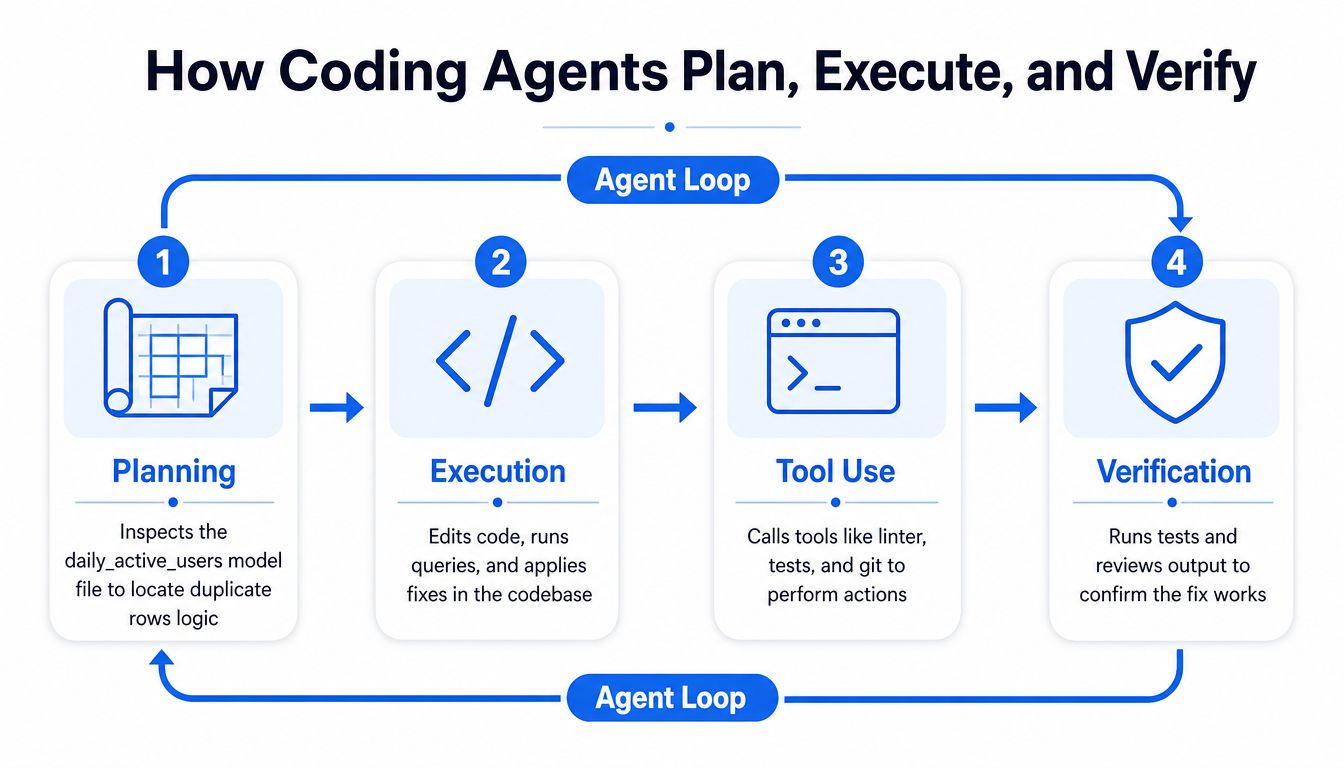
The tool layer matters because the agent needs a controlled way to call the shell, filesystem, Git, test runners, linters, and warehouse clients. It should select a tool based on observed output, not run commands without a reason. The verification step is what separates an agent from a single model call. Every meaningful action should be checked against an executable signal before the agent moves on.
Code execution has a measurable relationship with agent performance. A 2026 study found that coding agents used execution across all analyzed configurations, with an average of 8.8 test runs per task, ranging from 2 to 19, and an average execution success rate of 57.9%. Outcomes ranged from 30.4% for SWE-agent with GPT-4o to 79.3% for LiveSWEAgent with Claude-Opus-4.5. The study details these execution patterns and results. Teams can explore the underlying components in this overview of AI agent architecture.
Comparing Copilots, Autonomous Agents, and Warehouse-Deployed Agents
Not every AI coding product is equally agentic. The useful question isn't which category sounds most advanced. It's where the agent operates, what context it can access, what it can execute, and where a human must approve the result.
An IDE copilot sits beside the developer. It works well for local implementation, code explanation, and small test additions because the developer already holds the broader context. An autonomous pull-request agent works at repository level. It can interpret a scoped issue, modify several files, run checks, inspect failures, and propose a change for review.
A warehouse-deployed agent works closer to enterprise data. It can discover schemas, query warehouse tables, write SQL or Python, execute code in a governed runtime, validate results, and prepare a change request without requiring sensitive data to leave the environment.
Agentic coding tools compared
Category | How It Works | Best Fit | Primary Controls |
|---|---|---|---|
IDE copilot | Suggests or edits code while the developer directs the session | Local implementation, explanations, and small tests | Developer approval, editor permissions, repository rules |
Autonomous PR agent | Takes a bounded issue through code search, edits, execution, and a proposed pull request | Repository maintenance, test repair, and scoped migrations | Protected branches, test gates, review ownership, rollback |
Warehouse-deployed agent | Operates near schemas, SQL, Python notebooks, and governed warehouse compute | Data-quality repair, model maintenance, exploration, and lineage work | Read-only defaults, role-based access, cost limits, query audit logs |
The right choice depends on where the necessary context and credentials already live. A repository agent may be ideal for a Python package, while a data-quality problem may require catalog metadata and warehouse execution that an IDE cannot access efficiently.
The controls should be evaluated alongside capability. Ask who can review changes, whether actions are logged, whether execution is isolated, how compute costs are constrained, and how the team stops or rolls back an agent run. A practical progression moves from suggestions to bounded delegation as the evaluation and control systems mature.
For teams comparing developer tools, this guide to the best AI Python copilot provides useful context. The key decision isn't whether to replace every existing tool. It's whether the chosen agent can work safely at the point where the task occurs.
Real Use Cases for Developers and Data Teams
Agentic systems create value when a task requires several actions and has a clear success check. A developer might assign an agent to trace a failing test through the source and documentation, update an API client after a schema change, replace deprecated imports, or add tests around an existing module. The expected output should be a reviewable patch, an explanation of assumptions, and evidence from the relevant checks.
A broad request such as “clean up this service” gives the agent too much room to invent a definition of success. A better request names the repository, the files or component in scope, the constraints, and the checks that must pass.
Developer workflows
A bounded issue can follow a straightforward path:
Read the context. The agent reviews the issue, repository instructions, related files, and recent test failures.
Propose the change. It identifies likely files, risks, and the tests it expects to add or update.
Implement and execute. It edits the code, runs focused tests, and expands checks only when needed.
Return evidence. It provides the diff, test output, unresolved assumptions, and any requested human decision.
This works especially well for repetitive maintenance. It works less well when the requirement depends on an unstated product decision, an unfamiliar runtime state, or a security-sensitive architectural change.
Data-team workflows
Data teams can assign recurring operational work such as profiling an unfamiliar table, reconciling a model against source data, generating a dbt test, documenting lineage, or diagnosing a failed scheduled job. A warehouse-deployed agent can inspect the catalog, run SQL and Python in a sandbox, compare outputs, and attach the query text and validation results to a change request.
Suppose finance reports a revenue mismatch. The agent can inspect the model and upstream filters, compare the relevant grains, test a corrected query against accepted results, and present the evidence. It should not alter production tables or treat a plausible chart as proof.
A useful definition of done includes the code, the validation query, the observed result, and the assumptions that still need a human decision.
For teams designing this kind of workflow, AI agent use cases in data analytics offers a practical starting point. Querio is one example of a code-first workspace where an AI agent can write SQL and Python, with generated notebook cells, results, charts, and narrative available for inspection and editing.
Start with work that's frequent, reversible, and easy to verify. A model refactor, notebook cleanup, or test-generation task gives the team a clearer learning loop than an undefined mandate to “fix production.”
The Honest Risks and the Delegation Gap
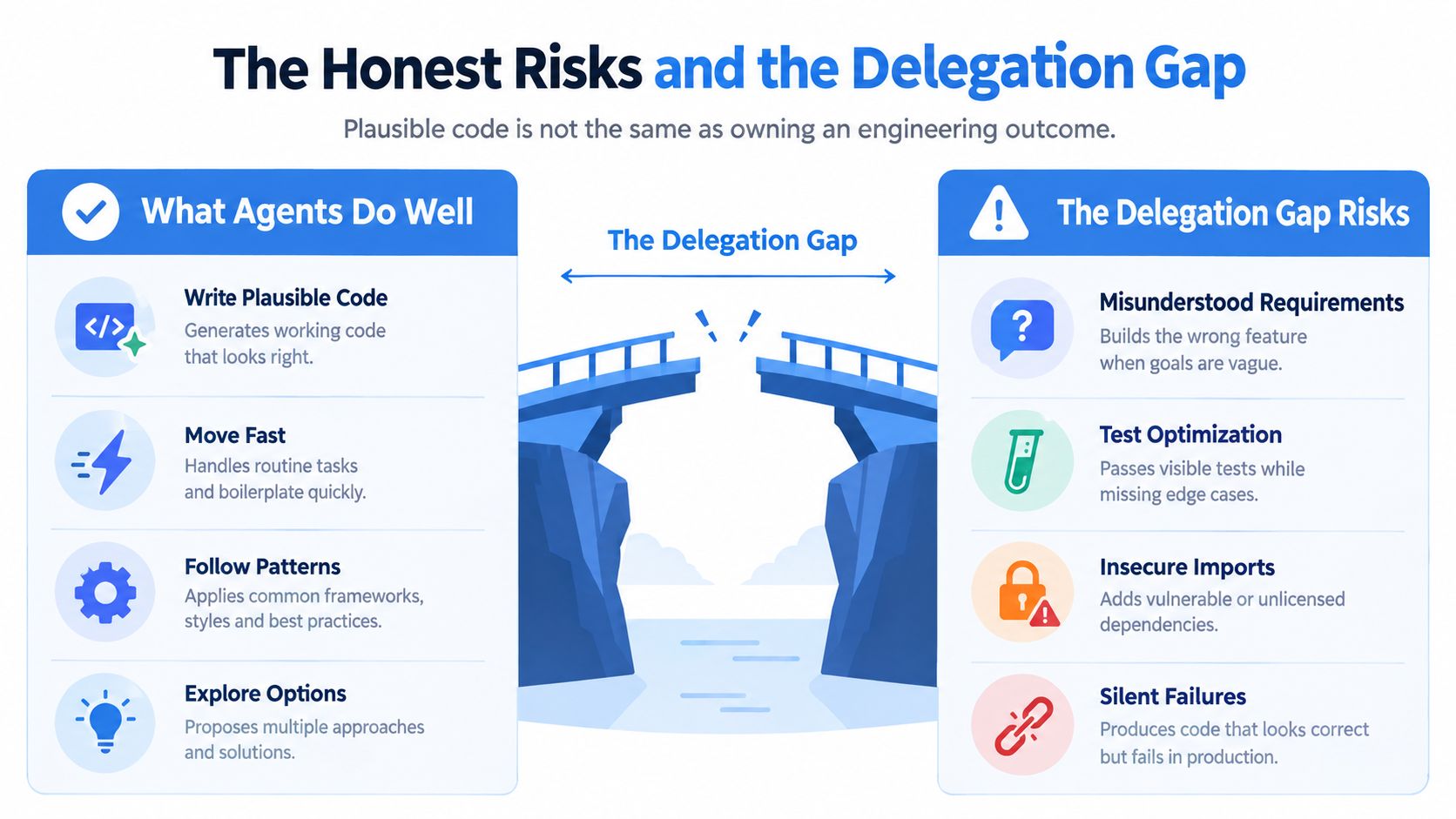
A coding agent can open a pull request that passes visible tests and still fail the outcome the team owns. It may misunderstand the requirement, optimize for test-shaped signals, add an unsafe dependency, or miss an edge case that appears only with production data. The delegation gap is the distance between generating plausible code and accepting responsibility for its behavior.
Survey evidence gives this gap useful context. Stack Overflow's 2025 AI survey found that about 70% of agent users said agents reduced time spent on specific development tasks, while 69% said agents increased productivity. Adoption is still incomplete, with 38% reporting no plans to adopt agents. As noted earlier, productivity gains do not by themselves show that teams can safely delegate outcomes.
A separate report describes the difference between assistance and delegation. It summarizes roughly 60% of daily coding work as AI-assisted, while full delegation remains around 0 to 20%. Trust, verification, and missing automated evaluation processes remain blockers. The report's discussion of the delegation gap places organizational readiness beside model capability.
Where production work becomes difficult
Long autonomous runs give each incorrect assumption more room to spread. An agent might edit many files, consume substantial warehouse compute, or create a change that is difficult to reconstruct. Data workflows add row-level permissions, sensitive metadata, concurrent workloads, nondeterministic results, and destructive SQL statements.
Warehouse deployment makes the boundary clearer. An agent that profiles a table or reconciles a model needs catalog access, query execution, and evidence capture. It should not turn permission to inspect data into permission to alter production tables. A plausible chart is an observation, not proof.
Benchmark results also require examination. SWE-bench Pro contains 1,865 tasks across 41 actively maintained repositories, and one 2026 analysis reported that about 30% of its public split contained broken tasks. The analysis explains why benchmark hygiene affects measured agent performance. A high score does not establish that an agent can handle changing schemas, hidden tests, permissions, or operational dependencies.
A controlled pilot should measure accepted tasks, rollbacks, escaped defects, review effort, compute use, and runs completed with verified evidence. Require least-privilege credentials, isolated execution, audit logs, cost ceilings, protected branches, and a named human owner. Include adversarial requests that attempt to bypass access controls or modify data outside the assigned scope.
A Practical Adoption Checklist for Teams
Adoption should look like an engineering change program, not a tool switch. Assign ownership before the first pilot, define what the agent may touch, and decide what evidence is required before a human can approve the result.
Start with a narrow workflow
Choose a task such as test generation, SQL refactoring, notebook maintenance, or documentation updates. The platform team should provide an isolated runtime and limited credentials. The engineering or data lead should define the acceptance checks, and a named reviewer should approve every change.
Build the control loop before expanding autonomy
Use this sequence as a planning checklist:
Define the scope. Write the repository, schemas, files, exclusions, expected outputs, and stopping conditions.
Instrument review. Require a human review for each agent-generated change, with the diff and execution evidence attached.
Sandbox execution. Start with read-only access or a development schema. Use dry runs and protect production branches and tables.
Measure outcomes. Track defects, rollback decisions, review time, test coverage, latency, and compute consumption.
Expand gradually. Move to broader tasks only when the evidence remains stable and the team knows who owns support and rollback.
The harness should include known regression cases and representative data conditions. A successful pilot isn't merely one that produces a good patch. It's one where reviewers can consistently understand what happened and intervene when the agent goes off course.
Autonomy is a permission that teams earn through repeatable evidence, not a setting they enable once.
Before moving beyond a pilot, hold a review with engineering, platform, data, security, and product owners. Decide which tasks remain human-led, which can be delegated with approval, and which may run automatically under strict conditions. Document on-call ownership and escalation paths so the agent doesn't create an operational gap after deployment.
What to Do Next With Agentic Coding
The central shift is from autocomplete to delegated workflow execution. Coding agents become more useful when they can access the context where work happens, whether that's a source repository, a CI environment, or a governed data warehouse with SQL and Python execution.
The delegation gap remains the practical constraint. Agents can reduce effort on specific tasks, but teams still need tests, review, permissions, audit trails, and a clear owner for consequential changes. The safest path doesn't begin with broad autonomy. It begins with a repeatable task whose result can be checked.
Pick one workflow, such as dbt model generation or notebook refactoring, and run a focused pilot using the checklist above. Record cycle time, review effort, defects, rollback decisions, and the quality of validation evidence. At the end, choose deliberately whether to expand, revise the controls, or pause.
Evaluation practices will mature as teams collect better production evidence. Organizations that treat agentic coding as an operational workflow, rather than a smarter autocomplete box, will be better positioned to delegate responsibly.
Querio lets data teams deploy AI coding agents directly on their warehouse to write SQL and Python in a code-first notebook workspace, with generated cells, results, charts, and narrative visible for inspection and editing. Visit Querio to explore a governed way to move from AI-assisted analysis toward reviewable delegation.