The Use of AI in Warehouse Management: 2026 Guide
Discover the practical use of AI in warehouse management. Explore applications, ROI, implementation roadmaps & data challenges for 2026.
https://www.youtube.com/watch?v=4EbjSBnPFiA
published
Outrank AI
use of ai in warehouse management, warehouse automation, supply chain ai, logistics technology, inventory management ai
ddec1c6a-2e83-40a9-860d-729c9e1e02fc

More than 90% of warehouses globally now use AI or advanced automation, and about 60% report advanced maturity in how they use it, according to Supply Chain Management Review on AI's role in warehouse operations. That should reframe the conversation for any executive still treating AI as a side project. In warehouse operations, AI has already crossed the line from innovation to baseline capability.
The question isn't whether the use of AI in warehouse management matters. It does. The harder question is why some companies get practical gains while others spend months on pilots, integrations, and dashboards that never change floor performance. In mid-market environments, the gap usually isn't model quality. It's data readiness, process discipline, and the ability to connect warehouse signals to operational decisions quickly enough to matter.
Table of Contents
The New Baseline for Warehouse Operations
Warehouse leaders don't need another futurist pitch. They need a clear read on what now counts as normal. AI already sits inside slotting logic, labor planning, replenishment recommendations, robotics orchestration, and inventory visibility. If your operation still relies on static rules, spreadsheet overrides, and delayed reporting, you're not comparing yourself to a future state. You're comparing yourself to a market that has already moved.
That matters outside the four walls too. Warehouse performance is tightly linked to transportation handoffs, dock scheduling, and network flow. Teams working on optimizing middle-mile logistics often discover the same truth: gains don't come from one isolated tool. They come from better decisions across connected operations.
What changed
The biggest shift is conceptual. AI in warehousing used to be framed as a bolt-on capability for large enterprises with robotics budgets. Today it's closer to infrastructure. Modern WMS, sensor networks, handheld workflows, and orchestration tools increasingly assume data-driven decisioning.
That creates two executive risks:
Competitive lag: Faster operators can process exceptions, re-slot inventory, and adapt workflows with less manual intervention.
False confidence: Buying AI features doesn't mean the warehouse is AI-enabled in practice.
Practical rule: Treat AI like a capability stack, not a software SKU. If your data, workflows, and frontline adoption aren't aligned, the algorithm won't rescue the operation.
Where leaders get tripped up
The conversation often starts in the wrong place. Leaders ask which vendor has the strongest AI module. They should ask whether location data, SKU attributes, movement history, labor events, and maintenance logs are usable enough to drive real decisions.
That distinction explains why the use of AI in warehouse management can look impressive in demos and disappointing on the floor. Mid-market operators don't usually fail because they lack ambition. They fail because their warehouse data lives across disconnected systems, local workarounds, and inconsistent naming conventions. AI amplifies operational discipline. It doesn't substitute for it.
Core AI Applications Transforming Warehouses
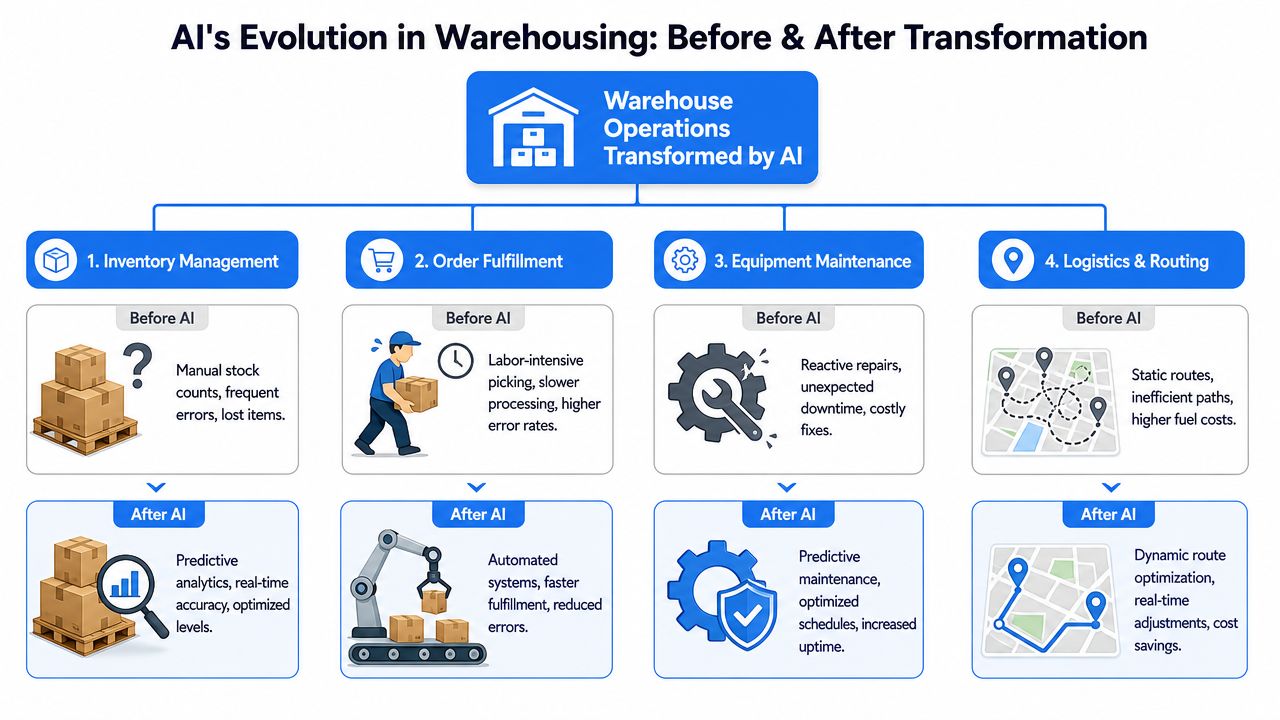
The use of AI in warehouse management is easiest to evaluate when you map it to specific operating problems. Not “intelligence.” Not “automation.” Actual bottlenecks. Travel time. Mis-slots. Unplanned downtime. Congestion. Order exceptions.
Dynamic slotting and smarter inventory placement
Traditional slotting often depends on periodic reviews. A supervisor looks at velocity reports, applies judgment, then updates locations in batches. That works until demand patterns shift faster than the review cycle.
AI-driven dynamic slotting changes the cadence. Oracle notes that these algorithms analyze historical movement data, product characteristics, and order frequency to recommend storage locations that can reduce picker travel time by 15% to 25%, according to Oracle's overview of AI in warehouse management. That is a practical improvement because travel time is one of the largest hidden drains in fulfillment labor.
Three conditions make dynamic slotting useful in practice:
Reliable movement history: Bad transaction timestamps produce bad location recommendations.
Usable product metadata: Dimensions, hazard classes, temperature needs, and handling rules must be complete.
Operational authority: Someone has to approve and enforce slotting changes before the floor drifts back into informal workarounds.
Fulfillment automation and exception handling
Picking and packing are where many executives first picture AI, often through robotics. That's only part of the story. The more durable gains usually come from orchestration. AI can prioritize work queues, cluster similar tasks, identify likely order exceptions, and direct labor toward the most time-sensitive tasks.
Computer vision also matters here. It gives systems a way to verify what moved, what's damaged, and where inventory is located when digital records drift from reality. In practice, that helps quality control and reduces the amount of manual checking required to keep confidence in the system.
For teams trying to connect warehouse decisions with broader supply chain data, this piece on AI use cases for supply chain data integration is useful because it focuses on the plumbing that often determines whether an AI workflow stays operational after launch.
Most warehouse AI value comes from reducing decision latency. The faster the system recognizes a mismatch and routes the right action, the less expensive the exception becomes.
Maintenance and routing decisions
Reactive maintenance still dominates too many operations. A conveyor, sorter, or lift degrades subtly, someone notices a problem late, then the warehouse pays in downtime, overtime, and backlog. AI helps by spotting patterns in equipment behavior and flagging maintenance needs before failure becomes visible to the floor.
Routing has a similar before-and-after pattern. Static travel logic assumes the facility behaves predictably. It rarely does. Congestion, staging changes, replenishment conflicts, and priority orders all disrupt ideal paths. A good route optimization algorithm is a useful reference point because it shows how routing logic improves when systems adapt to changing conditions rather than following fixed assumptions.
A practical way to think about these applications is this:
Operational problem | Old approach | AI-enabled approach |
|---|---|---|
Pick travel is too high | Periodic re-slotting reviews | Continuous slotting recommendations |
Orders pile up in waves | Manual reprioritization | Dynamic queueing and task sequencing |
Equipment failures surprise the team | Calendar-based servicing | Pattern-based maintenance alerts |
Aisles clog during peak periods | Fixed routes and local workarounds | Adaptive routing and reallocation |
The common thread is simple. AI is most useful where the warehouse has too many variables for static rules to keep up.
The Tangible ROI of a Smarter Warehouse
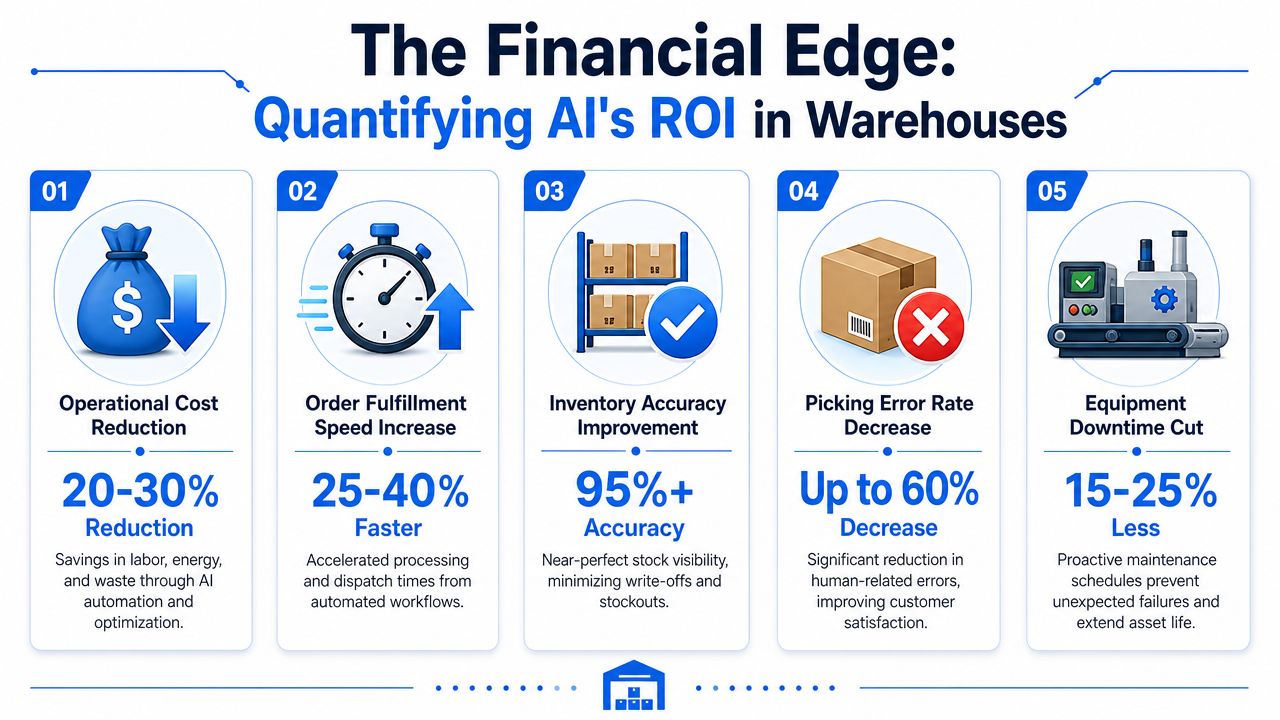
Executives shouldn't buy warehouse AI because it sounds modern. They should buy it when it improves the operating model. The strongest business case comes from linking AI to labor efficiency, throughput, error reduction, and asset utilization, then measuring whether those gains persist after go-live.
A broad market signal already exists. Kanerika reports that AI in warehouse management has shown the capacity to cut operating costs by as much as 50% for logistics companies, and current adoption is projected to support a 40% increase in overall logistics productivity by 2035, according to Kanerika's analysis of AI in warehouse management.
This visual captures how leaders often frame the business case:
Where financial gains usually show up first
Cost reductions don't appear as one line item. They show up in several places at once.
Labor efficiency: Better task allocation reduces non-productive movement and manual reprioritization.
Error containment: Fewer pick, pack, and inventory mistakes mean fewer rework loops and fewer customer service escalations.
Asset uptime: Predictive maintenance lowers the operational drag caused by surprise failures.
Working rhythm: Better forecasting and queue management reduce the chaos premium paid during peaks.
The mistake I see most often is evaluating ROI only through headcount reduction. That's too narrow. Many warehouses get more value from absorbing volume growth without adding proportional overhead than from trying to strip labor immediately.
For teams building the measurement layer behind these decisions, this guide to measuring ROI from AI and BI initiatives is a practical reference for structuring operational metrics so they're defensible in finance reviews.
The KPI view executives should use
AI initiatives should tie to a small set of operational KPIs. If a vendor can't explain that link clearly, the program is still in slideware territory.
Useful KPIs include:
Order accuracy rate: Does AI reduce the number of preventable fulfillment mistakes?
Dock-to-stock time: Are inbound decisions getting faster and cleaner?
Inventory turnover: Is the business moving inventory more efficiently because planning and placement are improving?
Cost per order: Are efficiency gains holding after training, supervision, and exception work are included?
This video gives a useful visual framing of warehouse AI ROI and operations:
The test isn't whether the dashboard looks smarter. The test is whether supervisors trust the recommendations enough to change how work gets done.
Enabling Technologies You Need to Understand
A lot of AI discussion becomes needlessly technical. Most warehouse leaders don't need to understand model architecture in detail. They need to know what each technology is good at, what data it depends on, and where it tends to break.
Machine learning as pattern recognition at scale
Machine learning is best thought of as pattern recognition that improves with exposure to operational history. In a warehouse context, it learns from order flows, SKU movement, receiving patterns, replenishment timing, and labor behavior. Then it uses those patterns to support decisions such as what to stock where, when to replenish, or which orders need intervention.
It isn't magic. It's closer to how recommendation systems learn preferences from repeated behavior. In warehousing, the “preference” is really an operational pattern. If your transaction history is noisy or incomplete, the model learns the noise too.
That's why data access matters so much. Teams trying to support forecasting, replenishment, or labor planning often need a more flexible analytics layer than the standard reports inside a WMS or ERP. This guide on using SQL and Python for AI demand forecasting is useful because it reflects how many data teams work when warehouse signals need to be modeled outside rigid reporting tools.
Computer vision and optimization engines
Computer vision gives machines context from images and video. In a warehouse, that can support quality checks, location verification, damage detection, and the reconciliation of physical inventory against digital records. Think of it as the system's eyes. It's especially valuable where barcode-only workflows leave blind spots.
Optimization algorithms play a different role. They are the decision engines that evaluate trade-offs. Which route creates less congestion? Which task should be assigned next? Which location best fits an item given velocity and handling constraints?
The practical divide is simple. Machine learning predicts what is likely. Optimization decides what to do about it.
A useful stack often looks like this:
Systems of record collect transactions from WMS, ERP, TMS, scanners, and sensors.
Machine learning models detect patterns and generate predictions or recommendations.
Optimization logic turns those predictions into task sequences, slotting plans, or routing choices.
Execution tools push actions to operators, robots, handhelds, or dashboards.
When that stack works, AI feels operational. When it doesn't, it feels like an analytics sidecar disconnected from daily decisions.
An Actionable AI Implementation Roadmap
Most warehouse AI projects don't fail at the idea stage. They fail in the handoff between concept and operation. Someone approves a pilot, a vendor promises rapid value, and then the team discovers that item masters are inconsistent, event logs are incomplete, and supervisors don't trust the recommendations.

Start with data before vendors
A warehouse AI roadmap should begin with a data audit, not a product demo. That means identifying where operational truth resides. WMS records may capture transactions, but vital context often sits in spreadsheets, handheld exports, maintenance systems, supervisor notes, or partner systems.
Check four things first:
Completeness: Are key fields consistently populated?
Consistency: Do product, location, and labor definitions mean the same thing across systems?
Latency: How quickly does new data become usable?
Ownership: Who fixes broken inputs when they appear?
If those answers are unclear, buying more AI won't help. It will only make data defects more expensive.
Pick a pilot that can survive contact with reality
The best pilot is narrow enough to control and important enough to matter. Dynamic slotting for one zone, maintenance alerts for one equipment class, or exception prioritization for one order stream are all more credible starting points than a warehouse-wide transformation promise.
A strong pilot has these characteristics:
Operational pain is already visible
Data already exists in usable form
Floor teams can validate outcomes quickly
Success changes a real KPI, not just a dashboard
Don't choose the pilot with the flashiest demo. Choose the one with the shortest path from data to changed behavior.
Integrate, operationalize, then scale
Pilot success doesn't mean you're ready to scale. It means you've earned the right to solve the harder problems. Integration is usually where that work begins. Recommendations have to flow into WMS workflows, maintenance systems, labor planning tools, or handheld processes in a way that doesn't create parallel operations.
A practical implementation sequence looks like this:
Audit the data layer: Resolve gaps in master data, event history, and system access.
Define one decision to improve: Not “inventory optimization,” but “re-slot fast movers in one pick module.”
Run a controlled MVP: Keep scope tight and involve floor supervisors early.
Integrate into daily workflows: If operators need extra manual steps, adoption will drop.
Review outcomes and edge cases: Study where the model was wrong and why.
Scale by process family: Expand to adjacent workflows only after the first one is stable.
Mid-market teams should be especially disciplined here. They don't have the luxury of carrying bloated AI programs that consume analyst time without changing operations. The right roadmap is usually less glamorous and more effective.
Navigating Critical Pitfalls and Governance
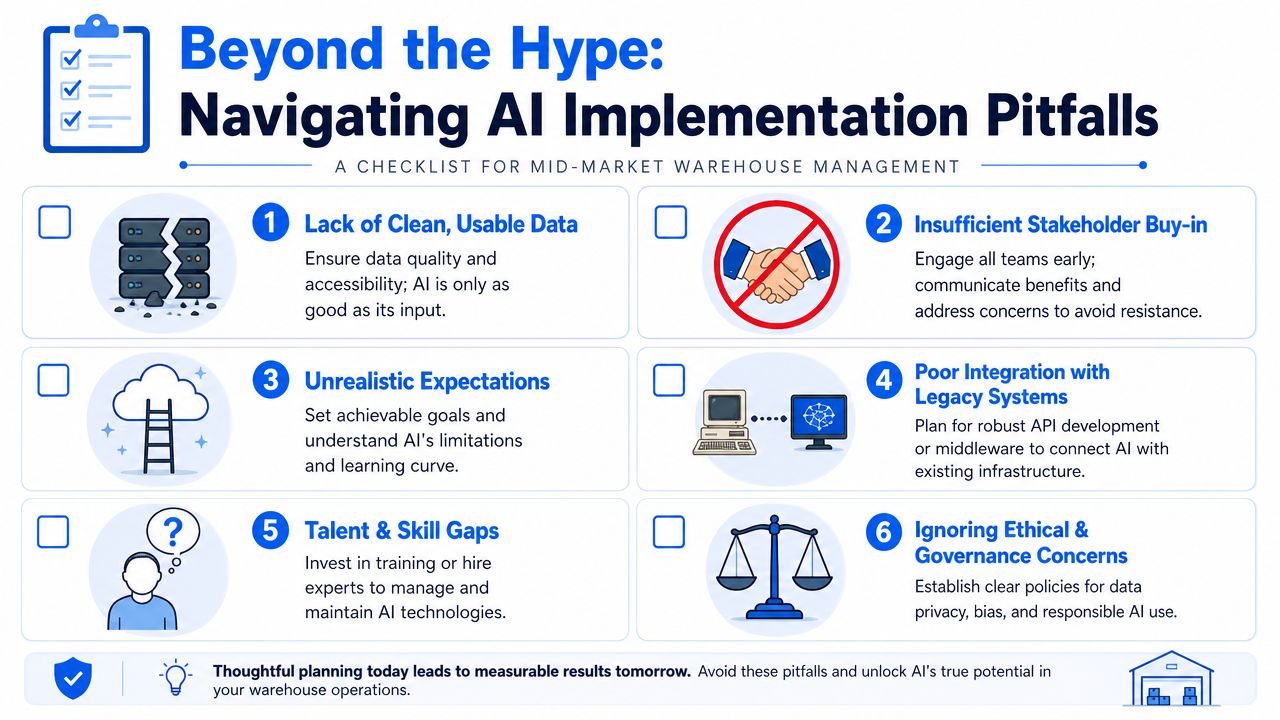
Most warehouse AI content oversells the upside and underweights the conditions required to capture it. That's a mistake, especially for mid-market operators with lean data teams and older system environments.
Supply Chain Management Review highlights a problem many executives recognize immediately: smaller facilities face a 30% to 50% implementation failure rate due to data fragmentation, and the “human API” bottleneck often delays ROI by 12+ months compared with projections, according to SCMR's coverage of Physical AI in warehouse operations. That is the operational reality behind a lot of disappointing AI rollouts.
Why mid-market projects fail more often
Enterprise case studies distort expectations. Large operators usually have stronger master data, deeper IT benches, and more tolerance for long implementation cycles. Mid-market firms often have none of those advantages.
Common failure patterns look like this:
Fragmented data sources: Inventory, labor, and maintenance signals don't reconcile cleanly.
Manual data mediation: Analysts spend their time cleaning and combining data instead of improving models.
Weak process standardization: The warehouse runs on local knowledge that never made it into the system.
Overly broad scope: Leaders try to automate several decisions at once and lose operational focus.
The “human API” problem is especially damaging. When every AI request depends on a few analysts or engineers manually preparing data, the whole initiative becomes fragile. Improvement slows, trust drops, and frontline teams stop waiting for the system to catch up.
Governance is operational not theoretical
Governance in a warehouse AI program isn't just about policy documents. It's about deciding who can change what, what data can be trusted, and how exceptions get escalated when the model's recommendation conflicts with floor reality.
Security and access also matter. AI integrations often pull data across WMS, ERP, sensors, and third-party tools. If permissions are sloppy, risk expands quickly. This guide on securing AI integrations and protecting data access is useful because it treats governance as an implementation concern, not a compliance afterthought.
Leaders should also widen their lens beyond warehouse software. Broader global AI governance insights are helpful for framing risk, accountability, and responsible deployment, especially when AI starts influencing labor allocation and operational prioritization.
Good governance doesn't slow warehouse AI down. It prevents bad automation from moving faster than your controls.
The labor question is more nuanced than replacement
One of the weaker narratives in this market is that AI's primary labor value comes from reducing headcount. In practice, many operations benefit more from workload balancing, shift planning, and exception reduction than from direct labor substitution.
Recent developments in 2025 show AI models recommending shift adjustments to avoid bottlenecks and burnout by forecasting labor needs, as described by Made4net's discussion of AI in warehouse management. But there is still very little public data linking AI adoption directly to lower injury rates or turnover in high-volume facilities. That means executives should be careful with claims they can't validate internally.
Another risk is algorithmic rigidity. If the system optimizes tasks too narrowly, workers can lose room to adapt to floor conditions the model doesn't fully capture, such as aisle congestion, unusual pallet conditions, or receiving disruptions. AI should support operator judgment, not flatten it.
A better governance question is this: where should the system recommend, where should it decide automatically, and where should a supervisor always retain override authority? Strong programs answer that upfront.
Your Next Move in Warehouse Intelligence
The use of AI in warehouse management isn't about adding a robot, turning on a feature, or claiming a smart warehouse label. It's about building a warehouse that can sense, decide, and adapt without forcing every decision through manual triage.
The companies that get value from AI usually do one thing well before anything else. They make warehouse data usable. They clean up location logic, item attributes, transaction history, and system access. Then they pick a problem narrow enough to solve and important enough to matter.
That approach also creates room for more human-centered gains. As noted earlier, AI models are now being used to recommend shift adjustments and reduce bottlenecks, even though public evidence tying those systems to lower injuries or turnover remains limited. That's a reminder to stay empirical. Measure what changes in your own operation. Don't inherit marketing claims as strategy.
If you're deciding on the next move, start with a data audit. Not a vendor bake-off. Not a robotics tour. A data audit. In warehouse AI, competitive advantage isn't having the most ambitious algorithm. It's removing the friction between operational data and operational action.
Querio helps mid-market teams turn overloaded data functions into self-serve infrastructure. If your warehouse AI plans keep running into fragmented data, analyst bottlenecks, or slow reporting cycles, Querio gives teams a way to query, analyze, and build on warehouse data faster without waiting on a human API every time a new question comes up.