AI Agent Architecture: Reliable Systems for Data Teams
Explore AI agent architecture and how to build reliable systems tailored for data teams in 2026.
https://www.youtube.com/watch?v=wh489_XT5TI
published
Outrank AI
AI agent architecture, agentic AI systems, LLM orchestration, data warehouse agents, AI observability
b4443867-5905-457f-95f2-71ce867d4933

The popular advice is simple: use a larger model, add more tools, and let the agent reason for longer. That advice works in demos because demos hide the conditions that break production systems. Real data contains ambiguous definitions, stale schemas, permission boundaries, malformed tool responses, and users who need an answer they can audit rather than an impressive chain of thought.
A reliable AI agent architecture treats the language model as one component in a distributed system. Orchestration, state, memory, tools, security, evaluation, and observability determine whether the system behaves predictably. Model capability matters, but it can't compensate for an unbounded loop, an undocumented state transition, or a SQL executor with no validation gate.
Table of Contents
Why Most AI Agent Architectures Fail in Production
Teams often replace the model after an agent fails. A date was misunderstood, the wrong table was selected, or an API received an invalid parameter. Those symptoms can come from ambiguous context, weak tool contracts, lost state, or missing traces. Changing providers will not correct those failures.
The production reliability gap sits in the surrounding system. An agent must preserve state, enforce permissions, validate actions, interpret tool results, recover from errors, and stop at a defined point. Model choice matters, but observability and bounded workflows usually determine whether a system can be tested, audited, and operated.
A 2025 practitioner survey based on 306 valid responses found that deployed agents were generally constrained systems rather than open-ended autonomous workers. 79% relied heavily on manual prompt construction, 70% used prompting of off-the-shelf models instead of weight tuning, and 74% depended primarily on human evaluation (practitioner survey on production agent systems). The practical implication is clear: prompt design, workflow controls, and review gates remain active engineering surfaces. Model weights are only one part of the system.

The reliability gap is a systems problem
A plausible final answer can conceal a broken workflow. One failed handoff may leave the agent with stale state, an unauthorized tool result, or an action that no longer matches the user's request. Production design therefore needs traceable transitions, explicit permissions, error handling, and a clear completion condition.
The survey reported that 68% of production agents executed at most 10 steps before requiring human intervention, while 47% executed fewer than five steps (production agent deployment findings). Short workflows are not necessarily weak. They are easier to test and observe when each step has a defined input, output, and checkpoint. An unbounded loop creates more failure paths without necessarily producing a better result.
Practical rule: If you cannot describe the agent's stopping conditions, state transitions, and permitted side effects, the architecture is unfinished.
Research surveys describe a shift from symbolic and hybrid architectures toward LLM-based orchestration after 2022, with systems organized around reasoning, planning, control, tool calling, and environmental interaction (survey of the agentic AI era). These capabilities explain the need for system-level controls. Agents now retrieve information, execute code, coordinate external services, and maintain state, so every boundary needs instrumentation and policy enforcement.
For rollout planning, Stoa's approach to AI agent rollout provides another perspective on introducing agent capabilities into existing operations. Start with observable, bounded workflows, then expand autonomy only when traces and evaluations show that the controls hold. That sequence usually matters more than selecting a larger model.
Core Components of Modern Agent Systems
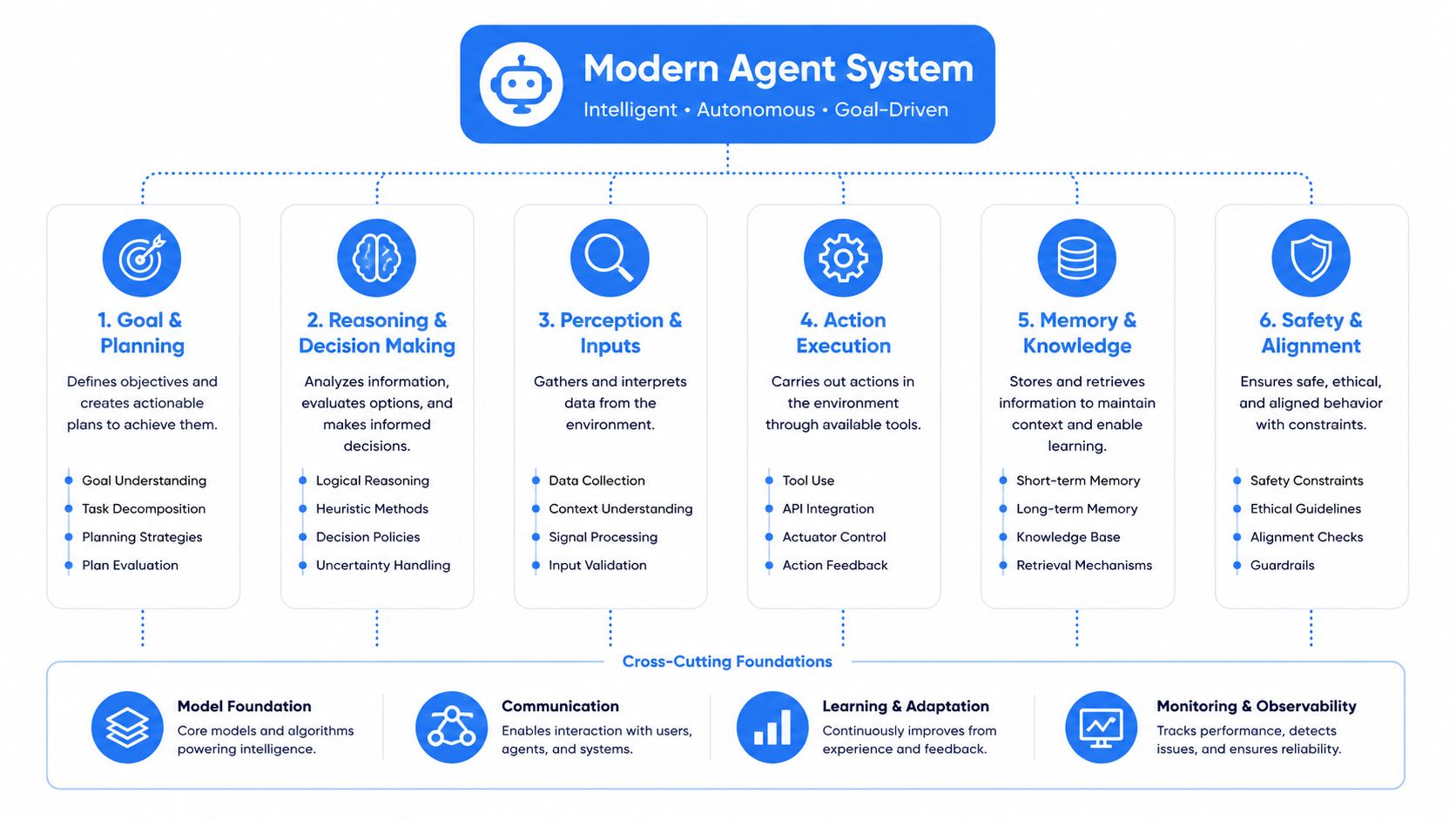
A production agent is easier to reason about when its responsibilities are separated into layers. The exact deployment boundary can vary, but the architectural roles should remain visible.
Five layers with different failure modes
The agent core handles model calls, prompt assembly, response parsing, and decisions about the next action. It shouldn't own every concern. Prompt templates belong under version control, and structured outputs should be validated before the orchestrator treats them as instructions.
The memory subsystem stores the context needed for the current task and, where justified, information that must persist across tasks. Conversation history, task state, retrieved warehouse definitions, and user preferences have different retention and access requirements. Mixing them into one large context object makes debugging difficult and increases the risk of stale or unauthorized context.
Tool adapters translate agent decisions into safe operations. A SQL executor, warehouse metadata retriever, Python runtime, and product API should each expose explicit schemas, timeouts, permissions, and error formats. The adapter, not the model, should decide whether a request is syntactically valid and authorized to run.
The orchestrator owns routing, retries, state transitions, deadlines, and human approvals. A state machine is often more reliable than a free-form loop for workflows with known stages. The model can interpret an ambiguous request or choose among approved actions, while deterministic code controls irreversible transitions.
Finally, the observability layer records traces, tool inputs and outputs, state changes, latency, token consumption, errors, and evaluation results. These layers can live in one service initially, but their contracts should stay independent so a malformed tool response doesn't corrupt memory or hide the original failure.
A warehouse analyst loop
Consider an analyst agent answering, “Compare activated users by plan for the latest reporting period.”
The agent core classifies the request and asks the metadata tool for approved tables, metric definitions, and date semantics.
The orchestrator creates a task state with the user identity, request, selected metric, and execution deadline.
The SQL adapter receives a structured query request, validates referenced objects, applies read-only permissions, and submits the query.
The result is normalized into a typed response. The memory layer stores only the task-relevant facts, not an indiscriminate copy of every intermediate result.
The agent interprets the result, checks whether the output satisfies the requested comparison, and either responds or requests clarification.
Observability records the full path, including the chosen definition, generated SQL, execution result, and final answer.
The most common handoff problems occur at boundaries. A tool returns a field as a string while memory expects a date. A schema changes but the prompt still describes the old column. A retry repeats a write because the adapter doesn't support idempotency. Independent contracts and typed validation prevent these errors from becoming invisible model failures.
Teams comparing implementation approaches can use this practical guide to building AI agents as a reference point, but the framework choice should follow the workflow's control requirements. A small, explicit service with durable state can outperform a complicated multi-agent framework when the job has limited branching.
Memory and Tool Integration as Design Levers
A warehouse analyst asks for a comparison, and the agent must decide which definitions, prior findings, and tools belong in the next step. Reliability depends less on how much context the system can hold than on whether it retrieves the right context and limits what each tool can do. The benchmark literature evaluates orchestration, prompt implementation, memory architecture, and thinking-tool availability as separate dimensions across 18 configurations, showing that the same base model can behave differently as those components change (enterprise agent benchmark framework).
Separate memory by lifespan
Use three tiers, each with a clear retention and access policy:
Ephemeral memory: The active conversation and immediate instructions. Keep only what the next decision requires.
Working memory: A task-scoped record of intermediate findings, selected entities, validation results, and pending actions. Store it in a structure the orchestrator can resume and inspect.
Persistent memory: Curated definitions, approved preferences, procedural knowledge, and indexed documents. Attach ownership, freshness metadata, retention rules, and access controls.
The tier should follow the information's lifespan. Long-term storage does not automatically improve answers. Saving every model-generated conclusion adds retrieval noise and can preserve an incorrect assumption after the source data changes.
Memory Tier | Typical Token Budget | Retrieval Latency | Best Use Case | Failure Risk |
|---|---|---|---|---|
Ephemeral | Small, limited to the active exchange | Minimal | Clarification and immediate context | Context overflow or accidental omission |
Working | Moderate, structured around one task | Low to moderate | Multi-step analysis and resumable execution | Stale intermediate state |
Persistent | Retrieved selectively from indexed sources | Variable | Definitions, procedures, and durable preferences | Irrelevant, outdated, or unauthorized context |
Context length is a poor substitute for retrieval discipline. Memory evaluations include LoCoMo and LongMemEval, which examine long-term consistency and recall behavior (memory and tool-use evaluation overview). For a data agent, persistent memory should favor metric definitions and approved business logic over raw conversation transcripts.
Make tools boring and explicit
Schema-first tools are easier to secure, test, and audit than dynamic discovery. Define required parameters, types, allowed values, timeout behavior, and error responses with JSON Schema or an equivalent contract. A SQL tool should accept a validated query plan or structured request, enforce read and write boundaries, and return typed metadata with the rows.
Dynamic discovery can help where tools change frequently, yet it also raises the risk of parameter hallucination, incompatible response shapes, and retry cascades. Put circuit breakers around external adapters. Set a maximum tool-call depth, stop retries for defined failure classes, and distinguish temporary service errors from invalid requests in fallback logic.
Memory and tools amplify one another's mistakes. A stale schema can produce a valid-looking but invalid call. A noisy response can pollute working memory and steer later decisions. Teams building embedded experiences can study AI-powered in-product guidance for ways to keep agent context tied to the user's active product task instead of turning it into a generic conversational archive.
Observability and Governance for Reliable Deployment
Production reliability depends on seeing the agent's complete trajectory. Logging only the final answer hides which state the agent entered, which tool it selected, what arguments it supplied, what the tool returned, how memory changed, and why the orchestrator continued or stopped.
Instrument the whole trajectory
Create trace-level spans for every model call, retrieval operation, tool invocation, validation gate, approval, and state transition. Attach correlation identifiers so an incident responder can connect a user request to the exact warehouse query and source metadata. Record prompt and tool versions, and redact secrets and sensitive values before storing traces.
Token and latency telemetry belongs beside semantic evaluation. A response can be fast and inexpensive yet answer the wrong metric. It can also be correct but too slow or costly for the product experience. As noted earlier, some deployed agents have exceeded 10,000 tokens in their prompts, making context growth an operational risk rather than a theoretical concern.
Quality must be tested before release, not inferred from production logs. A current 2026 synthesis reports that quality ranked as the leading barrier to production use, while observability adoption was near 89% and offline evaluation reached 52.4% (synthesis on agent production challenges). Instrumentation can explain a failure after users encounter it. Offline test cases and release gates prevent known regressions from reaching them.

Turn governance into runtime behavior
Governance belongs inside the agent loop. Useful controls include:
Query validation: Parse generated SQL, reject disallowed statements, verify referenced objects, and require a second validation step before execution.
Permission-aware tools: Derive access from the signed-in user and enforce row, column, and operation restrictions in the adapter.
Audit trails: Store the request, decision path, tool calls, approvals, outputs, and state mutations in an inspectable record.
Circuit breakers: Stop repeated failures, abnormal call volume, excessive context growth, and unexpected write behavior.
Semantic checks: Compare answers with approved definitions, expected schemas, and curated evaluation examples.
A syntactically valid SQL query can still answer the wrong business question. The guide to LLM SQL hallucination failure modes outlines practical checks for catching that class of error.
Build the control system in stages. Start with structured logs, add distributed traces, introduce offline and online evaluations, then automate anomaly responses after the signals prove trustworthy. Keep workflows bounded, require approval for consequential actions, and treat observability as part of deployment design rather than an afterthought.
Warehouse-Native Agents Versus Traditional API Patterns
Data agents face a deployment choice that model-centric architecture guides often understate. A traditional API pattern places orchestration and model calls outside the warehouse, then moves requests and results across network boundaries. A warehouse-native pattern keeps agent execution close to governed data and pushes computation into the platform that already stores it.
Neither pattern wins universally. The decision depends on query complexity, data movement, security requirements, and the team's existing operational model.
Dimension | API-Based Pattern | Warehouse-Native Pattern |
|---|---|---|
Data gravity | Moves metadata or results across services | Keeps computation close to stored data |
Analytical queries | Network handoffs can add coordination overhead | Joins and scans can use warehouse execution |
Security boundary | Requires synchronized service and warehouse permissions | Can align agent actions with warehouse controls |
Scaling | Scales orchestration services independently | Uses warehouse capacity and governance primitives |
Operational complexity | Familiar microservice deployment model | Fewer data movement paths, but tighter platform coupling |
Where each pattern fits
External orchestration works well when an agent must coordinate several SaaS systems, interact with application APIs, or serve multiple data backends. It also gives platform teams familiar control over queues, workers, deployment versions, and service-level policies. The cost is a larger trust boundary and more synchronization between application state, warehouse metadata, and user permissions.
Warehouse-native execution is attractive for agents that need to inspect large tables, join governed datasets, preserve analytical session state, or run Python and SQL close to the data. It can reduce unnecessary movement and make data access policy easier to align with existing warehouse roles. It doesn't eliminate operational concerns. Teams still need model versioning, sandboxing, query controls, trace storage, and a clear failure path when warehouse capacity or metadata is unavailable.
A hybrid design is often practical. Keep user authentication, request routing, approvals, and long-running workflow state in an external service, while pushing metadata retrieval, SQL execution, and data-heavy computation into the warehouse. This separates control-plane responsibilities from data-plane work.
For a deeper comparison of the stack implications, this analysis of warehouse-native AI analytics and lakehouse BI provides useful framing. The key question isn't whether warehouse-native architecture sounds modern. Ask where the data already lives, which system should enforce access, and which component can produce the most complete trace of each action.
Implementation Checklist for Data and Product Teams
Reliable delivery starts before the first prompt. Treat the agent as a product with explicit failure behavior, measurable boundaries, and an owner for every operational decision. Model selection matters, but unclear control flow and weak evidence collection usually cause production failures first.
Phase one defines the boundary
Choose bounded control flow: Document states, transitions, stop conditions, and human approval points before selecting an orchestration framework.
Limit tool authority: Separate read, analysis, and write tools. Begin with the smallest capability set that can complete the task.
Define success semantically: Specify what a correct answer or completed action requires, including sources, calculations, and user-visible explanations.
Select memory deliberately: Assign information to conversation context, task state, or persistent knowledge. Give durable memory an owner and freshness rule.
A design that calls the agent “general purpose” without listing permitted operations is a warning sign. Broad goals hide undefined permissions and make outcomes difficult to test.
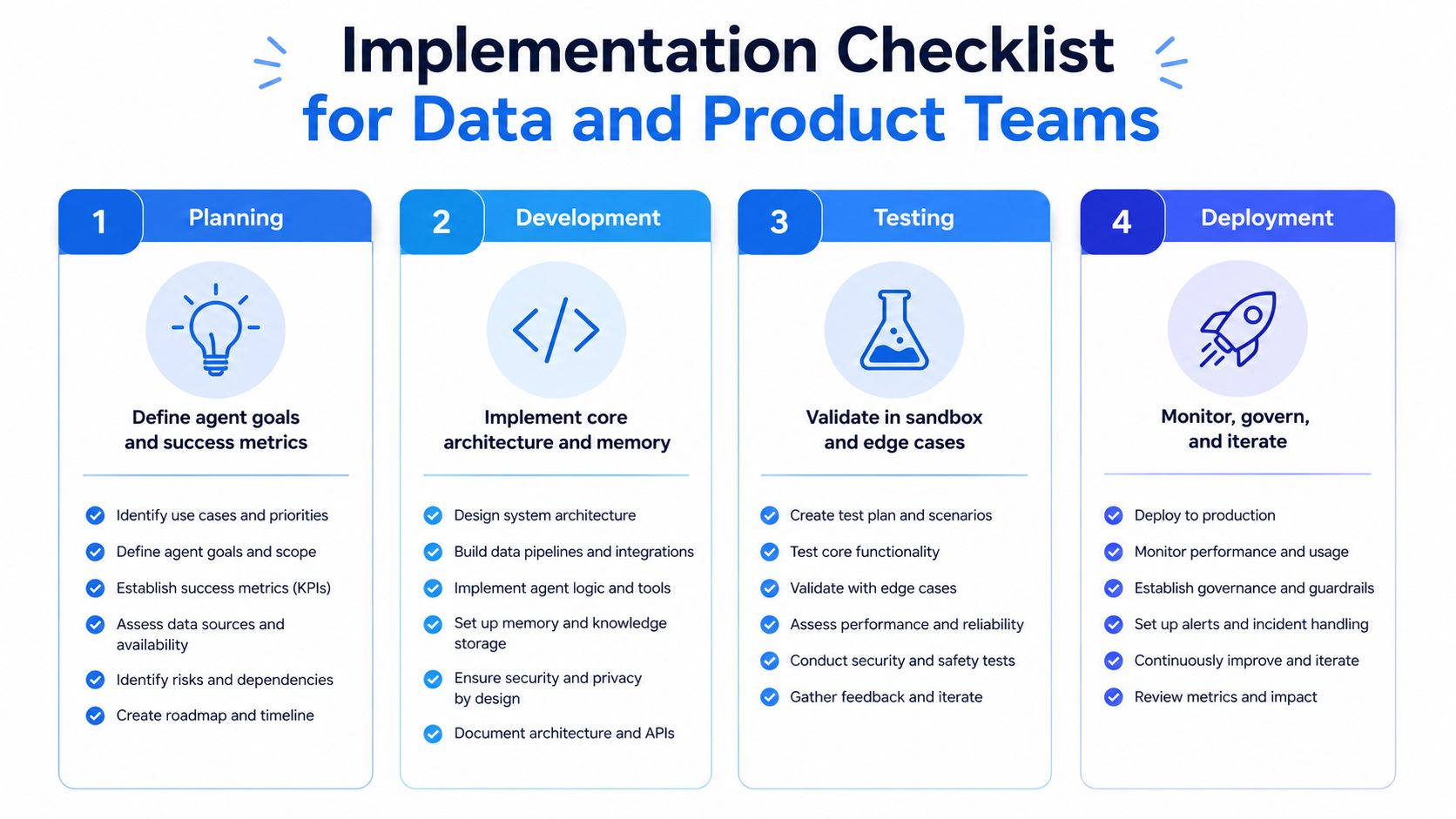
Phase two makes behavior inspectable
Instrument every model call, retrieval step, tool invocation, validation result, retry, and approval. Store cost and latency with each trace, and redact sensitive content before traces enter shared systems. Enforce identity-aware permissions at the tool boundary, because prompts cannot replace authorization.
For data teams, separate query generation from execution. Let the agent propose SQL, then run parsing, policy checks, schema validation, and resource limits before sending it to the warehouse. The validation layer should record why it rejected a request. Without that explanation, operators have little basis for diagnosing incidents or reviewing false positives.
Phase three tests trajectories, not just answers
Unit-test each tool with valid, malformed, unauthorized, and timeout inputs. Integration-test the state machine across successful paths, partial failures, duplicate responses, and resume behavior. Build an evaluation dataset from real requests, corrected answers, rejected actions, and known schema edge cases.
Review the path as well as the output. An agent can reach the right answer after unnecessary calls, use a disallowed source, or make a risky intermediate change that is later rolled back. Evaluation should cover memory, tool use, and planning separately, including execution correctness, redundant-call avoidance, recovery from invalid actions, latency, and API cost, as outlined in this agent evaluation benchmark mapping.
Phase four hardens operations
Add rate limits, deadlines, circuit breakers, idempotency keys, rollback paths, and an incident owner. Define responses for provider outages, warehouse schema changes, partial tool results, and rejected approvals. These cases should produce a known state, not an improvised retry loop.
Deployment dashboards should expose task completion, validation failures, tool errors, retries, permission denials, and unresolved approvals. These AI agent use cases in data analytics can help narrow an initial scope, but every selected use case still needs its own evaluation set, permission model, and operating policy.
Designing Bounded Agents That Teams Can Trust
Production reliability comes from constrained agency. The strongest agents are not granted broad control. Their authority matches the workflow, and every consequential action has a defined check, owner, and recovery path.
An unbounded loop can spend tokens revisiting a failed plan. A weak tool contract can pass malformed parameters. A warehouse agent with write access can introduce silent corruption without validation and rollback. Retries can amplify an incident when the orchestrator treats every failure as temporary.
Build reversibility into the architecture
Bounded agency gives the agent an explicit operating scope:
Action allowlists: Expose only the tools and operations required for the workflow.
Depth and cost limits: Stop execution when call depth, context growth, latency, or spend crosses a configured threshold.
Validation gates: Check SQL, schemas, data types, destinations, and business rules before side effects.
Human checkpoints: Require approval for destructive, external-facing, regulated, or financially consequential actions.
Rollback mechanisms: Make stateful operations reversible, or route them through a staged approval process.
Structured audit records: Preserve the request, decisions, tools, results, and approvals in a form an operator can inspect.
These controls do not remove model uncertainty. They limit its consequences and turn failures into testable signals. Engineers can then identify whether the problem came from planning, tool use, validation, or recovery instead of inferring defects from a polished final response.
Enterprise adoption also faces integration and governance barriers beyond model quality. Traditional systems were not designed for real-time agent interactions, while batch-oriented data architectures can complicate deployment. Industry research points to concerns involving communication standards, multistep error propagation, privacy, security, and intellectual property (Deloitte analysis of agentic adoption and enterprise readiness). Bounded workflows give teams a practical way to introduce agents without granting uncontrolled access to production systems.
Trust comes from predictable, inspectable, reversible behavior, not from giving the model more control.
For data teams, the first agent should usually handle a narrow, repeatable workflow with clear source data and a visible approval boundary. Expand its authority only after traces show that the boundary, rather than model capability, limits useful work. Evaluations should also show that the added capability remains governable under failure and partial recovery.
Querio provides a warehouse-connected workspace where data agents can analyze, explain, and operationalize work using real SQL and Python in a reactive notebook workflow. Teams designing bounded agents around governed warehouse data can visit Querio to assess how that operating model fits their analytics architecture.