Third Party Data: A Practical Guide for Modern Data Teams
Learn what third party data is, how it compares to first and zero party data, and how to govern and integrate it into your analytics stack.
https://www.youtube.com/watch?v=81tHxtsWMb8
published
Outrank AI
third party data, data governance, analytics stack, privacy compliance, data enrichment
413e891a-4f4f-4e60-b632-3d2e471f21ba

Most advice about third party data starts in the wrong place. It treats the subject as a cookie-deprecation problem and recommends replacing lost identifiers with more first-party collection. That matters, but it misses the harder operational question: can your company continuously inventory, classify, validate, govern, and remove external data after it enters the warehouse?
The distinction matters because third party data rarely remains confined to a campaign. It gets copied into transformation tables, joined to product events, reused in scoring models, and surfaced in executive dashboards. A vendor's collection practices, consent assumptions, retention terms, and security posture can therefore become part of your own analytics environment.
A 2023 academic study found third-party tracking on 98.6% of non-federal acute care hospital websites in the United States, while 94.3% of hospital homepages loaded at least one third-party cookie. The study examined 3,747 hospital websites and documented transfers to technology companies, social media companies, advertising firms, and data brokers, as described in this reference on the third-party data platform market. If highly regulated organizations can accumulate this external-data exposure through ordinary web infrastructure, a data team shouldn't assume its warehouse is insulated from the same problem.
Table of Contents
How Product and Growth Teams Use External Data in the Warehouse
Evaluating Vendors and AI Systems That Bring External Data In
Why Third Party Data Is Really a Governance Problem Now
Third party data is no longer primarily an ad-tech question. It is an enterprise governance and analytics-engineering problem spanning procurement, privacy, security, machine learning, and reporting.
The cookie debate focuses on browser identifiers, while teams continue onboarding enrichment feeds, intent scores, public-web datasets, partner files, SaaS exports, and AI services. Every source creates a dependency. After fields enter warehouse tables, the vendor relationship becomes less visible, even as its collection methods, consent assumptions, retention terms, and security risks shape downstream analysis.
The practical meaning of data governance extends into the warehouse. A team needs to know what entered the warehouse, why it entered, which controls apply, where it traveled, and how quickly it can be withdrawn. That requires inventory records, classifications, lineage, owners, and review points that remain accurate after schemas and use cases change.

Three pressures are converging
Regulators increasingly examine purpose, consent, transfers, retention, and evidence that controls operate. AI systems add another exposure. Teams may send external data into models, embeddings, classifiers, or agents without being able to inspect fully how the vendor collected or reused the underlying material.
Procurement adds a separate risk surface. One enrichment vendor can introduce new identifiers, subprocessors, geographies, and approved use cases. Recent industry reporting describes an average company working with 286 vendors, with 70% experiencing a breach in the last three years and 77% of those breaches originating with a third party, according to this third-party risk report.
The Australian Taxation Office's guidance separates controls that are designed effectively from controls that operate in practice. Missing evidence or significant concerns are treated as red flags, a principle reflected in its third-party governance review guidance.
Practical rule: Treat every external dataset as conditional infrastructure. Assign it a business purpose, an owner, a classification, a lineage path, and an exit plan.
The constraint on third party data value is governance maturity, not sourcing creativity. A clever source may produce useful signal, but only a controlled source can remain dependable when its terms, schema, collection method, or model-training policy changes.
What Third Party Data Is and Where It Comes From
Third party data is a structured or semi-structured dataset collected by an entity with no direct relationship with your end customer. In a warehouse, those rows sit beside product events, billing records, and support interactions. The integration also brings along the provider's collection method, consent posture, identity-resolution choices, freshness standards, treatment of missing values, bot filtering, and inferred attributes.
Source category therefore has operational consequences. It helps determine which controls analysts need before they can query the data and which assumptions must remain visible after ingestion.
Four source categories appear repeatedly
Licensed audience and demographic panels provide modeled attributes, household characteristics, or audience segments. The unit of record may be a person, household, device, or segment membership. Panel skew, modeled assumptions, and unclear update timing can distort comparisons, particularly when inferred attributes are treated as direct observations.
Behavioral and intent exchanges aggregate browsing, content, search, or engagement signals and convert them into topic or purchase-intent scores. These feeds can support prospecting and prioritization. Bot activity, advertiser noise, repeated page views, and opaque scoring rules can still make apparent interest look stronger than the underlying research.
Public-web and open-data scrapes collect pages, listings, documents, or records from publicly accessible sources. Public availability does not settle licensing, accuracy, or permitted-use questions. Stale snapshots, duplicated entities, incomplete deletions, and undisclosed joins may only become visible after ingestion.
Partner-shared CRM or transaction feeds are often more structured and may contain account, opportunity, purchase, or referral records. Their business context can make them useful for analysis, while consent language, matching procedures, retention rules, and update discipline remain the partner's responsibility and part of your review.
Source Category | Collection Method | Unit of Record | Common Failure Modes |
|---|---|---|---|
Licensed audience and demographic panels | Survey, modeled, or aggregated audience collection | Person, household, device, or segment | Panel skew, inferred attributes, stale snapshots |
Behavioral and intent exchanges | Web, content, search, or engagement observation | Device, cookie, account, or topic event | Bot contamination, advertiser noise, opaque scoring |
Public-web and open-data scrapes | Crawling, extraction, or public-record collection | Page, entity, listing, or document | Duplicates, stale records, undisclosed joins |
Partner-shared CRM or transaction feeds | Contractual file exchange or API delivery | Account, contact, transaction, or opportunity | Consent mismatch, late updates, retention ambiguity |
Make the pipeline carry the assumptions
The tools for building data pipelines matter less than the controls around the pipeline. Record the vendor name, collection description, contract owner, permitted purpose, refresh expectation, schema version, and matching logic as metadata. Procurement documents alone will not give analysts enough context to interpret a field months later.
A successful file delivery does not make a source approved for analysis. The ingestion layer should separate delivery from approval, validate schema and freshness, quarantine unexpected fields, and preserve the source snapshot that influenced a metric. That record supports investigation when a provider changes its collection method, definitions, or terms.
The harder task is continuous inventory. External data enters through vendors, partners, public sources, and tools that may later feed models or automated decisions. Each route creates a governance obligation: identify what arrived, classify its sensitivity and provenance, document its permitted use, and retain enough lineage to justify why it remains in the warehouse.
Comparing First Party, Second Party, and Third Party Data
The three categories differ less by their file format than by how far the data sits from the person or account your company is trying to understand.
First party data comes directly from your interactions with customers, prospects, users, or employees. Second party data is another organization's first party data, shared directly under an agreed relationship. Third party data comes through an external provider that may aggregate, license, infer, or resell information collected across many relationships.
That distance changes the review. A data team should ask not only whether a source is technically usable, but whether its origin and permitted purpose match the analytical question.
Criterion | First Party | Second Party | Third Party |
|---|---|---|---|
Origin | Your own product, service, or customer interaction | A known partner's direct customer or transaction data | An external provider's aggregated, modeled, or collected data |
Consent posture | Closest to your notice and consent process | Governed by partner terms and the sharing agreement | Dependent on the provider's collection chain and licensing |
Accuracy | Usually strongest for your own interactions | Often strong for the partner's domain | Variable, especially for inferred or modeled attributes |
Scale | Limited to your reachable relationships | Expanded through a defined partnership | Broad coverage across markets, audiences, or entities |
Regulatory exposure | Concentrated in your own collection and use | Shared across both organizations | Highest uncertainty across origin, transfer, purpose, and reuse |
Choose by analytical distance
First party data earns priority for activation, product measurement, retention analysis, and customer-level reporting because it reflects the relationship you manage. Its weakness is scope. It won't automatically answer questions about prospects you haven't reached, adjacent markets, or total category demand.
Second party data can be a strong fit for partner-cooperative use cases. A distributor might share transaction context, or a platform partner might provide account signals under negotiated conditions. The relationship is clearer than an open-market feed, but the external collection chain still requires review.
Third party data earns its place for enrichment, market sizing, competitive context, and cold-start segmentation. It can extend coverage where first party data has no visibility. The trade-off is heavier scrutiny around identity, consent, accuracy, provenance, and downstream use.
Use the closest data to the user that can answer the question. Moving farther away should be a deliberate trade-off, not the default.
This rule prevents a common analytical mistake. Teams often choose third party data because it offers more rows, then treat its attributes as equivalent to observed customer behavior. Scale expands the addressable universe, but it doesn't make an inferred field a fact.
Cost of Signal Loss in a Post-Cookie World
Cookie deprecation is only the visible symptom. The harder question is which measurement functions lose reliability when identifiers become less available or less consistent, and whether the warehouse can document that loss.
Google's testing found that removing third-party cookies without privacy-sandbox-style alternatives produced a 34% programmatic revenue decline for Google Ad Manager publishers and a 21% decline for AdSense publishers. An earlier study cited in the same Google Ad Manager explanation of cookie effects observed an average 52% revenue drop on top publishers.
These results describe publisher revenue under specific tests, not a universal forecast for every advertiser or warehouse. They identify a mechanism, however. Without cross-site signals, systems have less information for audience selection, frequency management, conversion association, and inventory valuation.
Signal loss has several forms
Retargeting pools become harder to assemble consistently when one user appears as different identifiers across browsers, devices, and consent states. Frequency capping becomes less dependable when the buying system cannot confidently recognize repeated exposure. Attribution becomes more ambiguous because the path from impression to conversion contains missing or probabilistic links.
Modeling suffers as well. A lookalike seed can shrink or become less representative, while a conversion model may learn from a biased subset of observable users. Campaign reporting can remain clean even as the measured population changes.
The warehouse should serve as the control point. Data teams can capture consent-stamped first-party events, preserve server-side transaction records, version identity-resolution logic, and compare platform-reported conversions with outcomes recorded in billing or product systems. Those controls make signal loss measurable instead of leaving it as a platform-side explanation.
For broader planning, marketing mix modeling offers a measurement path that does not depend on following every individual across sites. It cannot replace event-level analysis, but it can help teams assess channel contribution when user-level paths are incomplete.
The governance implication is larger than cookie support. Each external signal needs an owner, a documented purpose, a known refresh pattern, and a review path when consent rules, vendor terms, or AI oversight change.
Signal loss changes what the analytics team can responsibly claim about reach, influence, and return.
How Product and Growth Teams Use External Data in the Warehouse
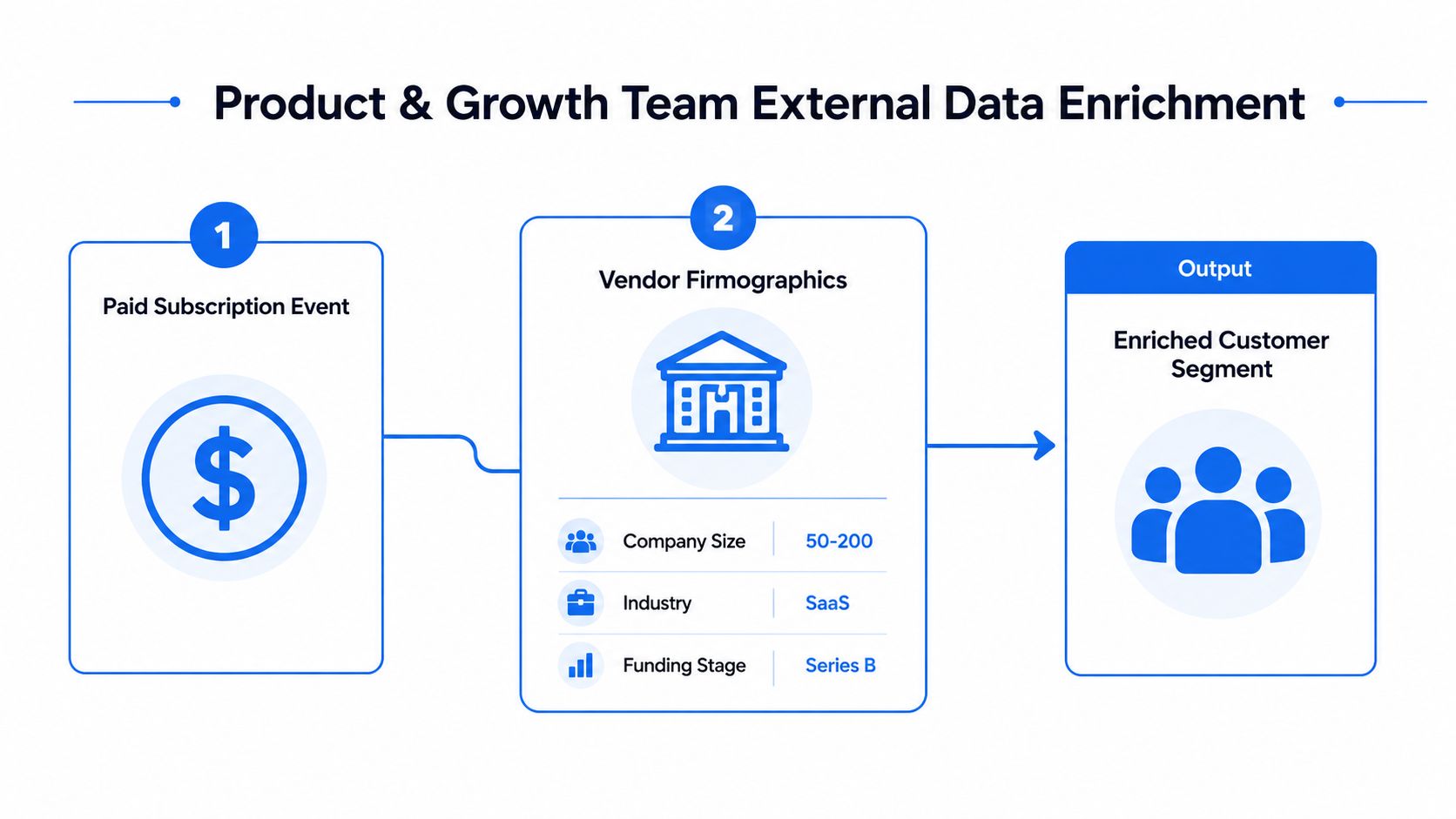
Consider a common warehouse pattern. A growth team has paid subscription events and wants to understand which accounts are most likely to activate, expand, or convert. A vendor supplies firmographic fields such as company size, industry, and funding stage, while another feed provides intent-topic scores.
The team passes a hashed identifier, matches the vendor records to an account or user key, and builds an enrichment layer rather than overwriting the original subscription table. From there, analysts can calculate activation and conversion rates by segment, compare acquisition channels within similar account groups, and feed qualified leads into a scoring workflow.
The join is where the promise meets reality
A vendor may deliver a full snapshot, an incremental update, or late corrections to prior records. A snapshot table can simplify point-in-time reporting but creates storage and comparison work. An incremental table is more efficient for ongoing changes, yet it requires careful merge logic, effective dates, and deletion handling.
The analytical benefit comes from separating observed behavior from external context. A subscription event remains an observed event. Company size or funding stage remains vendor-provided context. Intent remains a score with a collection and modeling history. Keeping those distinctions visible helps prevent a dashboard from presenting an inferred attribute as if it were a customer declaration.
The breakpoints are familiar:
Stale firmographics: An acquisition, reorganization, or funding event can make an account record inaccurate before the next vendor refresh.
Noisy intent: A topic score may reflect advertiser activity, automated browsing, or content consumption rather than serious buying research.
Unreviewed proxies: Demographic fields can influence prioritization in ways that deserve fairness and proxy-bias review before they reach scoring or activation.
Weak matching: A high match rate can still conceal systematic gaps if smaller accounts, international records, or anonymous users are harder to resolve.
The user behavior tracking perspective is useful here, but behavior and enrichment shouldn't be collapsed into one category. Maintain source-specific freshness expectations, test segment overlap against first-party populations, and add bias-lint checks before a field influences a customer-facing decision.
A disciplined team also records when each vendor value was valid, which identifier produced the join, and which model or dashboard consumed it. That turns enrichment from a silent lookup into a reviewable analytical dependency.
The following video offers additional context on the operational pattern:
A Maturity Model for Third Party Data Governance
Assessing governance maturity works best as a progression through stages rather than a static policy document. The practical test at each level is whether a team can produce evidence quickly, not whether an intention appears in a standard.
Level | Stage | Diagnostic Question | Cheapest Artifact | Next Action |
|---|---|---|---|---|
1 | Blind consumption | Can we name every external feed powering a report? | A manually assembled feed list | Stop unregistered ingestion and assign owners |
2 | Inventory | Do we know each source, contract owner, cadence, and schema? | A catalog record for every feed | Add automated freshness and schema checks |
3 | Classification | Are sensitivity and permitted-use tags attached to fields? | A source and column classification sheet | Connect tags to access policies |
4 | Lineage | Can we trace a dashboard field to a vendor version and date? | A lineage graph or transformation map | Add field-level provenance to models |
5 | Control evidence | Can we prove controls operated and respond to revocation or breach? | Audit logs, retention reports, and runbooks | Test controls and removal procedures regularly |
What each level changes
At Level 1, a vendor drops files into object storage and dashboards consume them. The diagnostic question is uncomfortable because the answer may emerge only after a broken report or during contract renewal.
At Level 2, the team creates an inventory covering source, owner, contract, refresh cadence, schema, and business purpose. Automation follows. A catalog that nobody updates creates a cleaner-looking blind spot.
Level 3 adds classifications such as public, aggregated, modeled, and PII-adjacent. Those labels should flow into column-level access controls, masking rules, and approved-use documentation. Classification also gives reviewers a basis for deciding whether a field belongs in a model, dashboard, or activation workflow.
At Level 4, lineage connects a vendor field to transformations, metrics, dashboards, and models. Revocation then becomes an engineering task with a defined scope, rather than a forensic investigation across warehouse tables.
Level 5 produces operational evidence. Audit logs, retention enforcement, subprocessor reviews, breach-notification runbooks, and tested removal procedures show that controls operate in practice. A governance program reaches this stage when it can demonstrate both who used an external field and what happened after its permitted use changed.
The sequence matters for budget decisions. Inventory exposes the feeds that require attention, classification determines the restrictions, lineage limits the blast radius of a change, and control evidence supports review. Teams that skip the early stages often buy governance software before they can define the records it needs to manage. Prioritize the move from blind consumption to inventory before adding another platform.
Evaluating Vendors and AI Systems That Bring External Data In
Vendor onboarding should resemble regulated software procurement, not a self-serve signup. Price and coverage matter, but they're downstream of two questions: is the data fit for the analytical job, and can the company defend the risk posture?
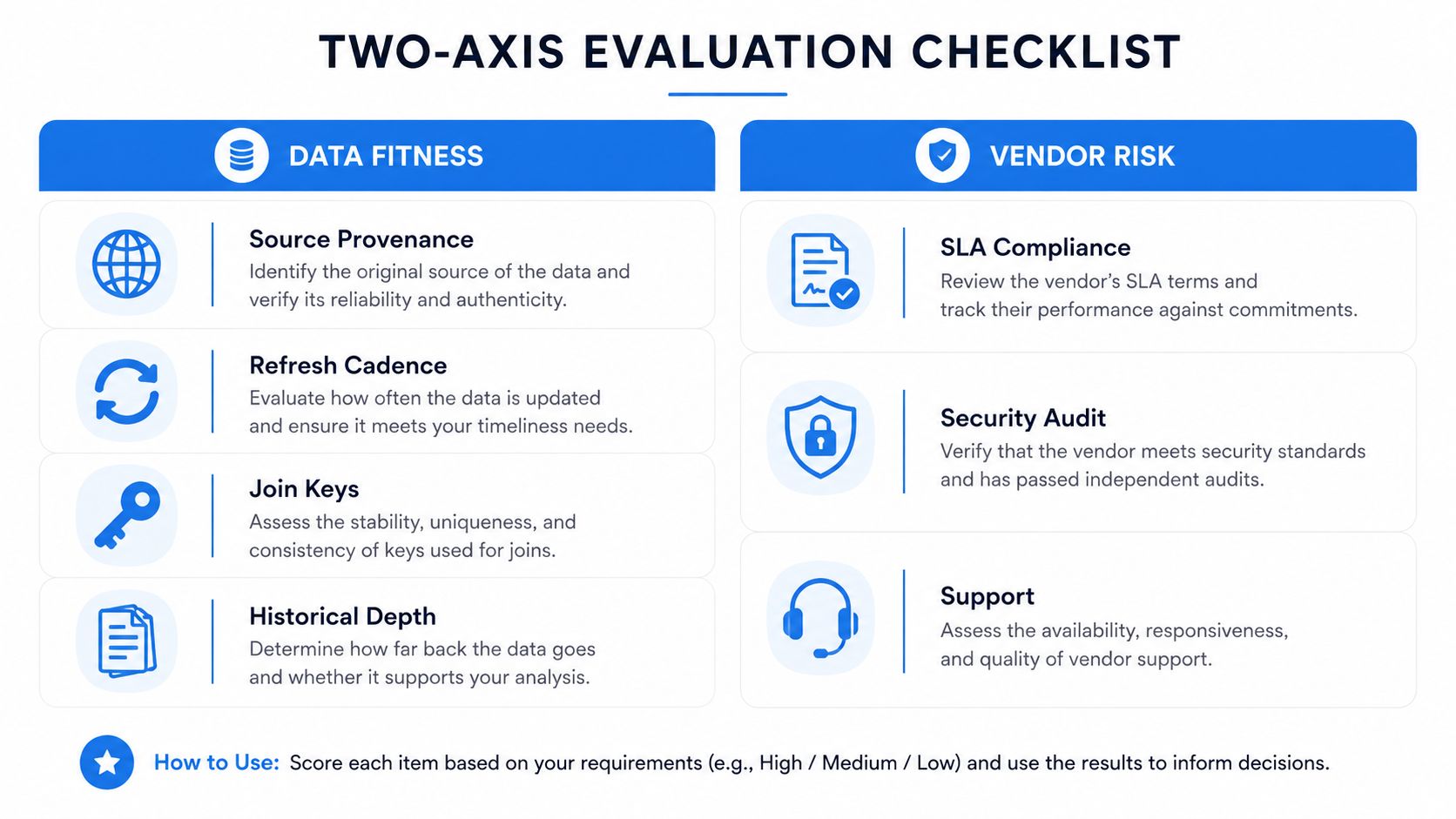
A two-axis review keeps those questions separate. Data fitness concerns whether the source can support a reliable join and a stable measurement process. Vendor risk concerns whether the provider can explain, protect, restrict, and, when necessary, remove the data.
Test fitness before negotiating price
Request a representative sample and test it against first-party truth. Check provenance, refresh cadence, join keys, historical depth, schema stability, missingness, duplicate entities, and the behavior of late-arriving updates. A source that can't match reliably or explain its historical state will create more warehouse work than its coverage justifies.
Don't accept a vendor's score as self-explanatory. Ask what the score represents, what signals contribute to it, how quickly it changes, and whether the provider can distinguish observed values from modeled attributes.
Review risk as a living record
The vendor record should include subprocessors, security audit material, breach history, contractual protections, retention terms, permitted uses, change-notification commitments, and a deprecation policy. The record belongs alongside the data catalog, so legal, security, procurement, and analytics can revisit it when a contract or data practice changes.
AI features need a separate review. Ask whether embeddings, classifications, or scores are derived from data the vendor has rights to use, whether your data can train a shared model, whether usage can be revoked, and whether the vendor can identify the inputs behind a consequential output.
A successful file transfer proves delivery. It doesn't prove fitness, lawful use, or operational control.
That distinction is central to third party data governance. The data team should preserve the evidence supporting approval, record the exact dataset version evaluated, and define the conditions that trigger re-review.
Principles for Using Third Party Data Without Regretting It
External data should earn its place repeatedly. Treating a vendor feed as a permanent growth lever encourages teams to keep paying for a source after its match quality declines, its terms change, or its original business hypothesis disappears.
Four principles create a more durable default.
Justify each dataset. Write down the decision the source is meant to improve, the first-party baseline used for comparison, and the evidence that would support renewal. A dataset without a specific hypothesis becomes general-purpose infrastructure, which usually means nobody owns its failure.
Review value and cost together. Engineering maintenance, privacy review, access controls, monitoring, incident response, and removal work belong in the cost of using the source. A feed can be commercially affordable and operationally expensive.
Classify before ingestion. Apply sensitivity and permitted-use tags before the first production table is built. Default access should reflect the classification, not wait for an incident or a dashboard request.
Prepare to remove it. Store lineage from contract to raw delivery, transformation, metric, and dashboard. Define what happens when a vendor revokes permission, changes its collection method, suffers a breach, or stops supporting a field.

This posture avoids two expensive failure modes. The first is silent drift, where deprecated or degraded data continues powering decisions. The second is surprise exposure, where a vendor's origin, subprocessor, or reuse policy changes before the warehouse lineage reveals where the data went.
Querio can give teams a workspace for querying and analyzing warehouse data alongside connected external sources, including systems such as BigQuery, Snowflake, HubSpot CRM, Google Drive, and QuickBooks Online. If your team needs to turn third party data into reviewable analysis without making analysts a permanent bottleneck, visit Querio to assess how its warehouse-connected approach could fit your governance and self-service workflow.