Data Warehouse and Datamart Architecture Guide
Master data warehouse and datamart architecture. Learn when to use each, avoid governance debt, and scale self-serve analytics for modern data teams.
https://www.youtube.com/watch?v=KPy4Cy7eC-8
published
Outrank AI
data warehouse and datamart, data architecture, data mart, data governance, self-serve analytics
74ed9212-857a-45fc-8452-6c5ad9059eca

Most advice about a data warehouse and datamart assumes every department eventually needs its own physical store. That assumption is outdated. A separate mart can improve focus, but it can also duplicate transformation logic, split metric definitions, and turn a fast analytics fix into long-term governance debt.
The better question for founders and product leaders is not, “Which department needs a mart?” It's, “What's the lightest architecture that gives people fast, trusted answers?” In many modern stacks, the answer is a centralized warehouse with a governed semantic layer. Physical marts still have a place, but they should be deliberate products, not the default response to every request for a dashboard.
Table of Contents
Rethinking Departmental Data Stores
The traditional playbook is simple: build an enterprise warehouse, then create a sales mart, a marketing mart, a finance mart, and more as the business grows. That pattern made sense when central systems were difficult to query, compute was constrained, and departmental reporting needed tightly controlled extracts. It's a poor default when cloud warehouses can expose governed data directly to analysts, applications, and AI-assisted tools.
A new mart often starts with a reasonable request. A product leader wants faster retention analysis. Finance wants a stable reporting dataset. Marketing needs campaign data without navigating operational tables. The data team copies a subset, adds transformations, and ships a useful experience. The trouble starts when another team recreates similar logic from a different source.
Practical rule: Build a physical mart only when it solves a durable architectural problem, not merely an inconvenient user experience.
The hidden cost is governance debt. Every isolated store needs ownership, freshness monitoring, access controls, documentation, tests, and a process for reconciling its metrics with company-wide definitions. If the marketing mart calculates active customers differently from the product dashboard, both teams may be correct within their own pipelines and still disagree in an executive meeting.
A semantic layer addresses the usability problem without automatically creating another copy of the data. It can expose approved metrics, dimensions, joins, and permissions while keeping the warehouse as the integration point. Teams exploring data warehouse reporting should evaluate the reporting interface and metric layer separately from the storage architecture.
This shift doesn't make marts obsolete. A dependent mart can still provide a stable contract for regulated reporting, a high-volume customer-facing product, or a workload that needs a carefully optimized physical model. But “one department, one mart” is no longer a sound scaling strategy. Start with governed warehouse access, then add a mart when the evidence shows that a logical layer can't meet the requirement.
Core Concepts of Centralized and Focused Storage
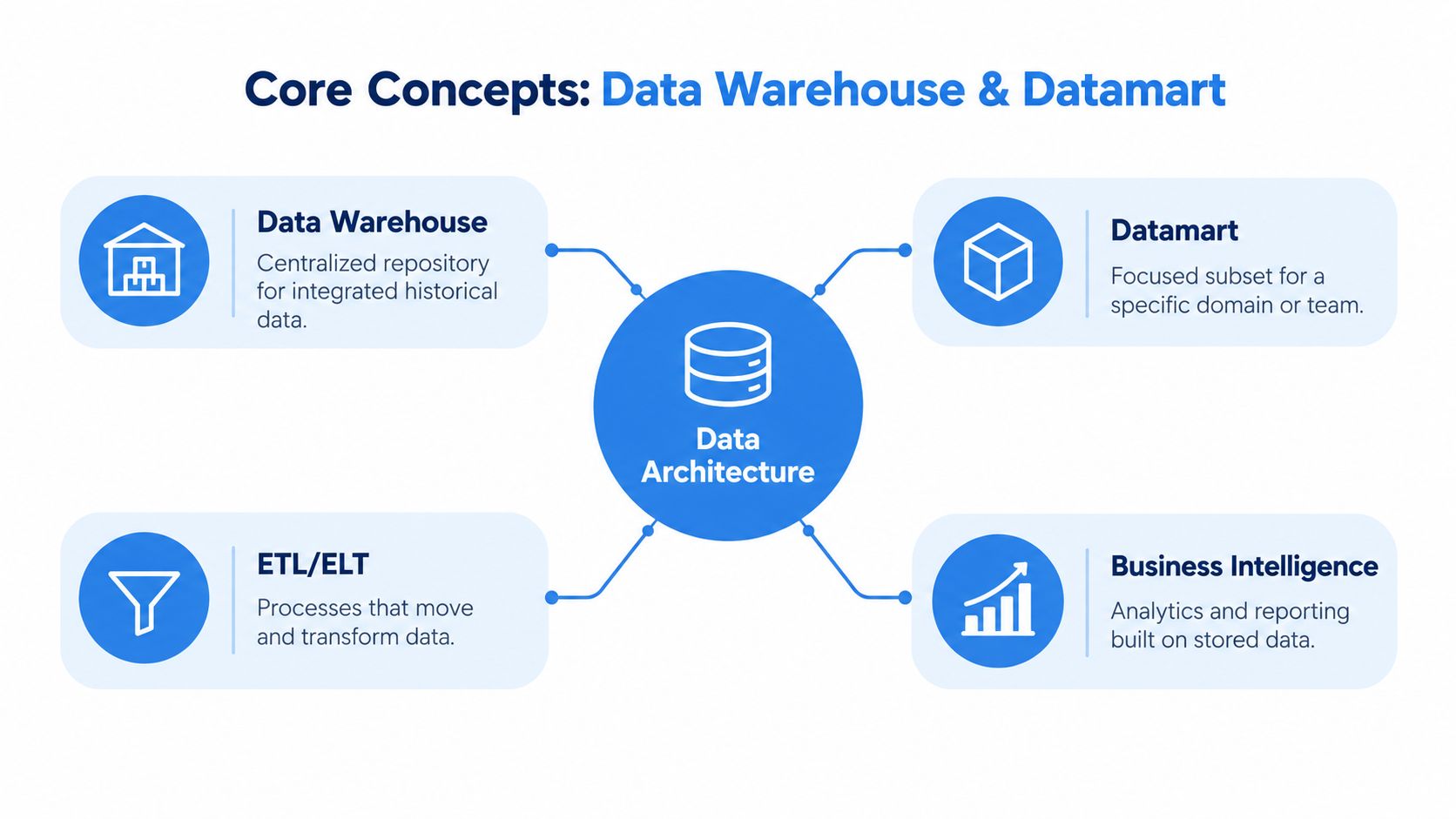
Think of a retail business with a central archive. The archive receives sales transactions, customer records, inventory events, support interactions, and product activity from many systems. It preserves the organization's broad analytical history and gives data engineers a place to integrate definitions across sources.
That archive is the data warehouse. It's designed for cross-functional analysis, historical reporting, transformation, and controlled access. A warehouse might contain raw or lightly transformed data, modeled facts and dimensions, shared business definitions, and curated datasets for downstream tools.
A datamart is the reference desk built for one audience. The finance desk might expose invoices, payments, recognized revenue, and accounting dimensions. The marketing desk might organize campaign activity, leads, spend, and conversion events. Users don't need to search the entire archive because the desk presents a narrower, more approachable collection.
How the data moves
The architecture usually follows a sequence:
Source systems generate records. Product databases, payment platforms, CRM tools, advertising systems, and event pipelines create operational data.
ETL or ELT moves the data. ETL transforms data before loading it. ELT loads data first and transforms it inside the warehouse.
The warehouse integrates the information. Engineers standardize keys, timestamps, entities, and business logic across systems.
A mart or semantic layer serves a use case. The output may be a physical subset, a view, a governed metric definition, or a notebook-ready dataset.
Business intelligence tools consume the result. Dashboards, reports, notebooks, product surfaces, and automated agents use the governed data.
The structural choice matters because it determines where complexity lives. In a centralized model, integration happens once and downstream users share the result. In a departmental model, the team may simplify the schema and limit the available data, but it also takes responsibility for maintaining that specialized boundary.
Modeling for humans and machines
Warehouse models often prioritize integration, lineage, and reusable relationships. A mart can use a narrower star-style model or another denormalized structure that makes common departmental questions easier to write and faster to run. The correct model depends on the workload, but the principle is consistent: centralize shared meaning, specialize presentation only when the use case requires it.
For a deeper treatment of relationships, grain, and analytical structure, use this guide to data modeling in a data warehouse. Product leaders don't need to design every table, but they do need to ask whether a proposed mart creates a reusable data product or just hides an inconvenient warehouse schema.
Dependent Versus Independent Architectures
The most important distinction isn't the department a mart serves. It's where the mart gets its data.
A dependent datamart is fed from the central warehouse. The warehouse handles source integration and shared transformations, then the mart applies a focused presentation model or additional domain-specific logic. An independent datamart pulls directly from operational databases, files, APIs, or other external systems, bypassing the central warehouse.
That difference changes the governance burden immediately.

Dependent marts
A dependent mart inherits the warehouse's integration work. If customer identity, subscription status, and revenue events are standardized centrally, the mart can reuse those definitions instead of reconstructing them.
Its main strengths are:
Consistency: Shared warehouse models make company-wide comparisons easier.
Lineage: Engineers can trace mart fields back through the central transformation layer.
Access control: Security policies can be applied through established warehouse governance.
Operational clarity: The warehouse remains the primary source for integrated analytical data.
The trade-off is that a dependent mart can't outrun the upstream model indefinitely. If the warehouse lacks a required source or business definition, the mart must wait for that foundation or introduce carefully documented logic of its own. The build may feel slower than a direct extract, but the resulting architecture is easier to operate.
Independent marts
An independent mart can look attractive during an urgent project. A small team connects directly to a CRM export or production database, creates a focused model, and gets a dashboard working without waiting for central data engineering.
That speed comes from bypassing shared infrastructure. It also creates repeated work:
Duplicated pipelines: Multiple teams extract and transform the same entities.
Conflicting definitions: Each mart may interpret customer, order, churn, or revenue differently.
Fragile dependencies: Source schema changes can break several marts independently.
Siloed access: Analysts may struggle to combine departmental data with company-wide context.
Unclear ownership: The team that created the mart may not be responsible for it later.
Independent marts can be justified for a prototype, an isolated workload, or a temporary migration boundary. They shouldn't become the permanent backbone of enterprise reporting. If you approve one, assign an owner, document its sources, define its retirement condition, and record which metrics intentionally differ from the warehouse.
The fast path is only fast if you count the maintenance work you avoid creating.
For most growing startups, the recommendation is straightforward: prefer dependent marts. Use independent marts only when delivery urgency or source constraints justify the governance cost, and treat that cost as an explicit architectural decision rather than an accidental side effect.
Performance Trade-offs and Query Latency
Performance is the strongest argument for a physical mart. A focused dataset can reduce the number of joins, columns, filters, and irrelevant records a query must process. It can also give a BI tool a simpler model, which matters when business users generate queries without understanding the underlying warehouse structure.
Comparative testing cited in the supplied research reported 10.14 ms query performance for the data mart model, with the mart outperforming the tested star schema and snowflake models for query performance and delivering faster data presentation overall. See the comparative data mart performance study for the reported result and test context.
Architecture Model | Query Latency | Data Presentation Speed | Primary Use Case |
|---|---|---|---|
Data mart model | 10.14 ms in the cited test | Faster in the reported comparison | Focused departmental analytics |
Star schema | Not specified in the verified data | Slower than the tested mart in that comparison | Structured analytical reporting |
Snowflake schema | Not specified in the verified data | Slower than the tested mart in that comparison | More normalized analytical modeling |
The table illustrates a useful principle, not a universal benchmark. Query latency depends on warehouse engine, data volume, clustering, partitioning, concurrency, SQL shape, caching, materialization, and BI behavior. You shouldn't promise a mart will produce the same result in Snowflake, BigQuery, Redshift, ClickHouse, or PostgreSQL without testing the actual workload.
When physical narrowing helps
A mart earns its keep when it creates a stable, repeatedly used performance boundary. Examples include a dashboard with many concurrent users, a customer-facing analytics feature with strict response expectations, a finance dataset that must preserve a controlled reporting snapshot, or a domain model whose joins are too complex for self-service users.
The value isn't just fewer rows. It's predictable workload design. Engineers can precompute expensive logic, select only relevant columns, establish a clear grain, and tune the result for known query patterns.
When duplication is a habit
A physical copy is unnecessary when the warehouse can handle the workload through views, materialized views, clustering, partitioning, caching, or a semantic layer. Creating a mart merely because users find the warehouse confusing treats a modeling and interface problem as a storage problem.
Start with a query profile. Identify the slow models, expensive joins, repeated calculations, and dashboards that create contention. Then test a governed view or materialized result before introducing another pipeline. The right question is not whether a smaller table is faster in theory. It's whether the performance gain justifies another object with its own freshness, ownership, and reconciliation obligations.
The Shift Toward Semantic Layers and AI Agents
The modern alternative to a physical mart is a semantic layer over shared warehouse data. Instead of copying a departmental subset, the team defines approved metrics, dimensions, joins, filters, and access rules once. Users then interact with a business-facing model while the warehouse remains the place where integrated data lives.
That approach separates two needs that legacy architectures often combine. Users need focused questions and understandable fields. They don't necessarily need a physically separate database. A semantic layer can provide the first without automatically creating the second.
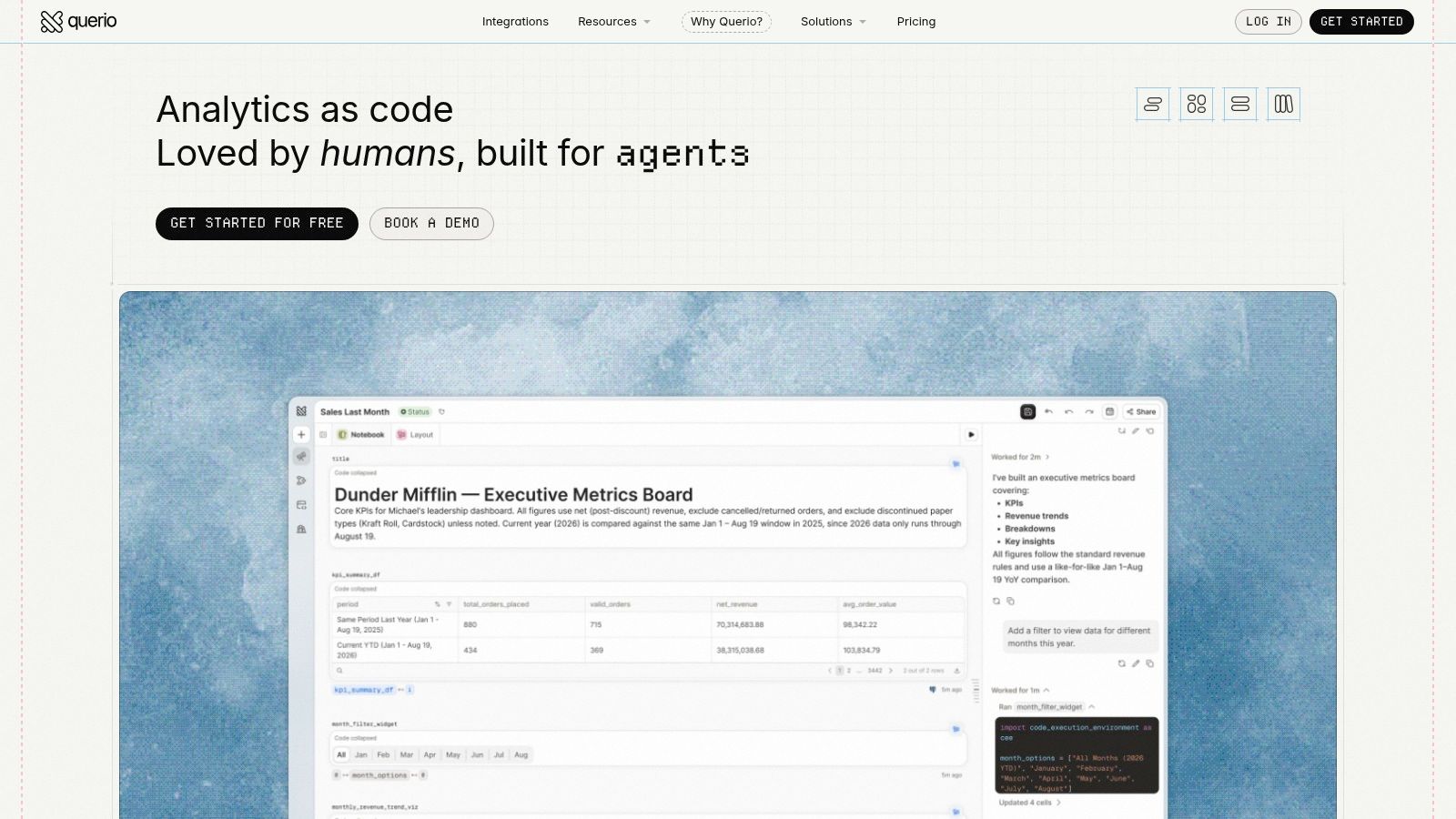
This matters for startup teams because self-service analytics fails when every request becomes a ticket. A product manager shouldn't need an engineer to explain which event table contains activation data. A founder shouldn't receive three versions of net revenue because each dashboard encodes a different definition. A data engineer shouldn't spend the week translating ordinary business questions into SQL that repeatedly reproduces existing logic.
A semantic layer provides the shared contract. AI agents provide a more accessible interface to that contract. Properly governed agents can generate SQL or Python, inspect available models, apply metric definitions, and produce analysis without granting every user unrestricted access to raw operational tables.
Why open table formats change the decision
Modern architecture discussions increasingly position the warehouse as a query and governance layer over open table formats, lakehouse storage, external data, and AI-enabled workflows. That reduces the pressure to create departmental copies to make new data available to a team.
The architecture becomes:
Integrated storage: Keep source data and shared models in the central platform.
Semantic definitions: Expose trusted metrics and relationships.
Role-aware access: Give each team only the data it should use.
AI-assisted exploration: Let users ask questions in natural language while the system generates inspectable queries.
Reusable outputs: Turn validated analysis into dashboards, notebooks, product features, or scheduled reports.
Read this overview of semantic layers and their core benefits before treating a new mart as the only route to self-service.
The video below provides another perspective on warehouse-centered analytics and agent-assisted workflows.
AI doesn't eliminate governance. It makes governance more important because an agent can produce a polished answer from a poorly defined metric. Give the agent governed models, clear metadata, row-level permissions, query logging, and a review path for new definitions. The winning pattern isn't “AI instead of data engineering.” It's AI on top of data engineering that has made the warehouse understandable and safe.
Choosing the Right Pattern for Your Team
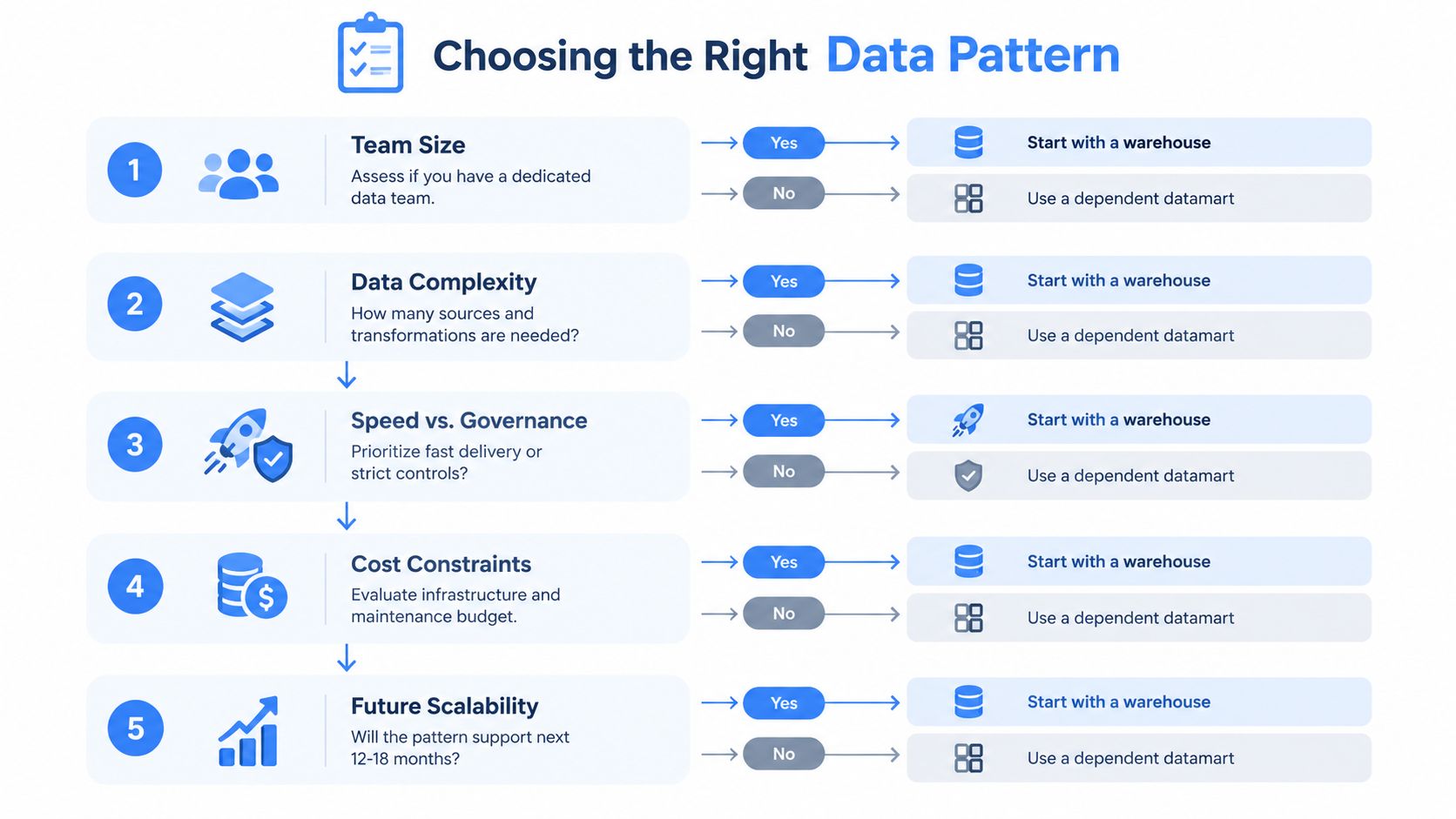
Use a decision matrix instead of adopting a mart because another company has one. Your choice should reflect the workload, the risk of inconsistent definitions, the maturity of the data team, and the cost of maintaining another analytical boundary.
Start with direct warehouse access
Choose direct access through governed models when:
The team is small: You can't support many pipelines, schemas, and ownership boundaries.
Definitions are still changing: Centralizing logic makes revisions easier to propagate.
Users need exploration: Analysts and product teams ask questions that don't fit a fixed departmental schema.
The warehouse already performs well: Views, materialized results, and query optimization solve the latency issue.
You want one metric contract: Revenue, active users, retention, and conversion should mean the same thing across teams.
This is the default I recommend for most startups. Build clean warehouse models first, then expose them through a semantic layer, notebooks, dashboards, or controlled query tools.
Add a dependent mart for a durable boundary
Build a dependent mart when at least one of these conditions is real:
Regulatory reporting requires stability: Finance or compliance users need a controlled dataset with documented lineage and repeatable output.
A customer-facing product needs predictable performance: External users shouldn't compete with exploratory internal queries.
The domain model is complex: A carefully designed mart can hide difficult joins and preserve a stable interface.
Access isolation is necessary: A focused dataset can simplify permissions when broad warehouse access is inappropriate.
Repeated workload tuning has a clear payoff: The same expensive logic runs often enough to justify materialization.
A dependent mart should have an owner, a defined grain, freshness expectations, tests, documentation, and a retirement plan. Without those controls, it's just another unmanaged copy.
Treat independent marts as exceptions
An independent mart may be acceptable when the central warehouse doesn't yet contain the needed source, a prototype must validate demand, or a temporary migration requires a separate boundary. Before approving it, write down why central access won't work and what would allow the team to consolidate later.
Audit your current architecture with three questions:
Can two teams produce different answers to the same business question?
Does anyone know who owns each pipeline and metric?
Are users asking for a new mart because of performance, permissions, or usability?
Those answers reveal whether you have a genuine storage requirement or a semantic and interface gap. Fix the gap at the lowest layer possible. Don't create a physical dependency when a governed model would solve the problem.
Scaling Analytics Without the Bottleneck
Your data architecture should make the data team more effective, not turn engineers into a permanent request queue. The central warehouse should hold integrated truth, while semantic definitions, permissions, and approachable interfaces let product, finance, marketing, and leadership answer routine questions independently.
That requires discipline. Don't let every team publish its own version of core metrics. Don't let an urgent dashboard become a permanent independent mart. Don't optimize theoretical latency while ignoring the cost of duplicated pipelines and unresolved ownership.
Cloud warehouses and marts now sit inside a broader analytics system that includes open table formats, semantic layers, notebooks, AI agents, and customer-facing data products. Teams evaluating their data warehouse analytics architecture should map each requirement to the smallest durable layer that can satisfy it.
Cost belongs in that decision. For teams operating Snowflake, this practical guide to 2026 Snowflake cost optimization can help connect workload design with warehouse spend, especially before you materialize more data or add more scheduled transformations.
The recommendation is direct: centralize shared truth, expose it through governed semantics, and build dependent marts only for clear performance, security, reporting, or product boundaries. That pattern gives users speed without making the data team a human API.
Querio connects to warehouse data without duplicating it, then lets technical and non-technical users ask questions, generate SQL or Python analysis, and work through dashboards and notebooks on governed data. Visit Querio to evaluate a warehouse-centered self-serve analytics workflow before creating another departmental mart.