P Value Interpretation: A Guide for Product Teams
Master p value interpretation for product analytics. Go beyond p < 0.05 to make smarter decisions with A/B tests, effect size, and confidence intervals.
https://www.youtube.com/watch?v=vemZtEM63GY
published
Outrank AI
p value interpretation, statistics for product, A/B testing, data-driven decisions, hypothesis testing
2dafbd29-e078-426b-9e31-e2ecd0d57599

Your experiment just finished. The dashboard says p = 0.04. A designer wants to ship the new flow today. An engineer asks whether the lift is real. Your finance partner wants to know if this changes forecast assumptions. One number suddenly carries product, engineering, and revenue consequences.
That's where a lot of teams get into trouble. They treat p values like traffic lights. Green means ship. Red means stop. But p value interpretation doesn't work that way. A result just below a threshold can be weak evidence. A result just above it can still matter. And neither tells you whether the business impact is large enough to justify the work.
For product teams, the cost of getting this wrong is practical, not academic. You can spend a sprint scaling a feature that only looked promising because of noise. Or you can kill a useful idea because the evidence was messy, early, or poorly framed. Good teams don't just ask, “Is it significant?” They ask, “How strong is the evidence, how big is the effect, and is this worth acting on?”
Table of Contents
Why Your P Value Interpretation Can Make or Break a Product
A product manager runs an A/B test on a new onboarding prompt. The result comes back with p = 0.04. Someone says, “Great, it's significant.” The team starts planning rollout.
That response sounds disciplined, but it can still be reckless.
A p value near the common cutoff can support a very different decision depending on context. If the change is easy to reverse, low-cost, and targeted at a small segment, moderate evidence may be enough. If the same result is being used to justify a major architecture change, pricing shift, or lifecycle rewrite, it probably isn't.
The business cost of shallow interpretation
Teams usually make one of two expensive mistakes:
They overreact to a small win: A barely significant result gets treated like proof. Engineering time gets committed before anyone checks whether the improvement is meaningful.
They underreact to ambiguity: A result that doesn't clear the usual threshold gets dismissed, even when the estimated effect could still matter operationally.
They skip decision framing: The test answer gets separated from the decision it's supposed to support. That breaks the whole data-driven decision-making process.
Practical rule: A p value is evidence about noise under a specific assumption. It is not approval to ship.
This matters even more in fast-moving product organizations. The faster your team can launch tests, the easier it is to accumulate false confidence. A weak interpretation habit compounds across roadmap planning, experiment review, and executive reporting.
The strongest teams don't replace judgment with statistics. They use statistics to sharpen judgment. That starts with understanding what a p value is saying.
What Is a P Value Really Telling You
Most confusion starts with one bad mental model. People see a p value and assume it tells them the chance the experiment “worked.” It doesn't.
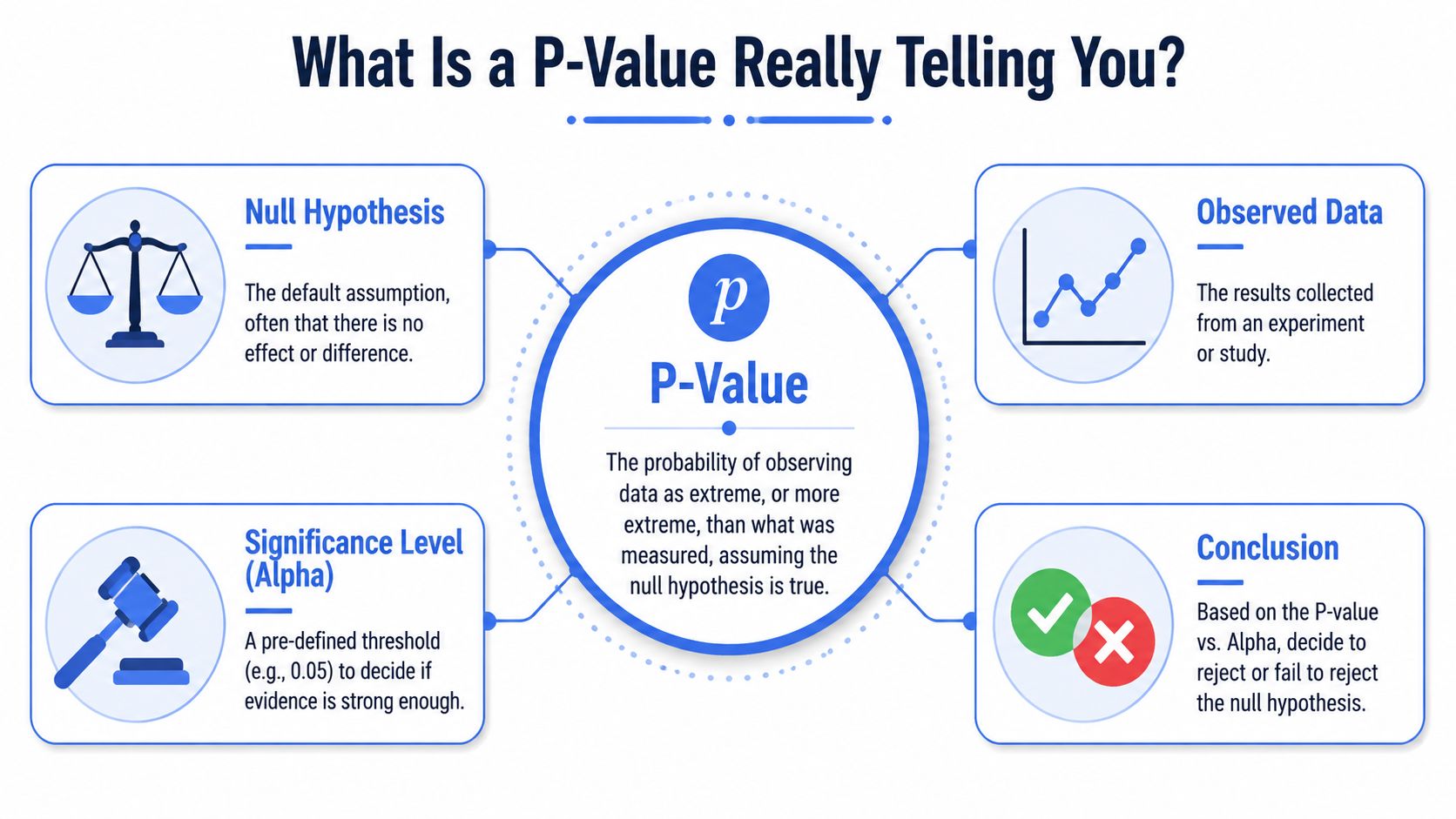
A p value is about how surprising your data would be if the null hypothesis were true.
Start with the null hypothesis
Use a courtroom analogy. In product experiments, the null hypothesis is the default claim that the new feature has no effect. Think of it as “innocent until proven guilty.”
Your experiment collects evidence against that default. The p value measures how unusual your observed result would be if that default were true.
If you want a primer on the broader idea of drawing conclusions from samples, this overview of descriptive and inferential statistics examples is a useful complement.
What the p value actually means
The formal definition is this: the p value represents the probability of obtaining test results at least as extreme as the result observed, under the assumption that the null hypothesis is correct.
That sounds abstract, so make it concrete. If your test produces p = 0.02, that means that if the null hypothesis were true and the study were repeated indefinitely, about 2% of those hypothetical tests would produce results as extreme as or more extreme than what you observed.
That's why smaller p values count as stronger evidence against the null. They mean your result would be less common under the “no effect” story.
What it does not mean
The American Statistical Association said in 2016 that p values do not measure the probability that the studied hypothesis is true, nor the probability that the data were produced by random chance alone. That statement matters because both mistakes still show up in product reviews.
Here's the clean distinction:
Interpretation | Correct or incorrect |
|---|---|
“The p value is the probability the feature has no effect” | Incorrect |
“The p value is the probability of seeing data this extreme if the feature had no effect” | Correct |
“A low p value proves the feature works” | Incorrect |
“A low p value is evidence against the no-effect assumption” | Correct |
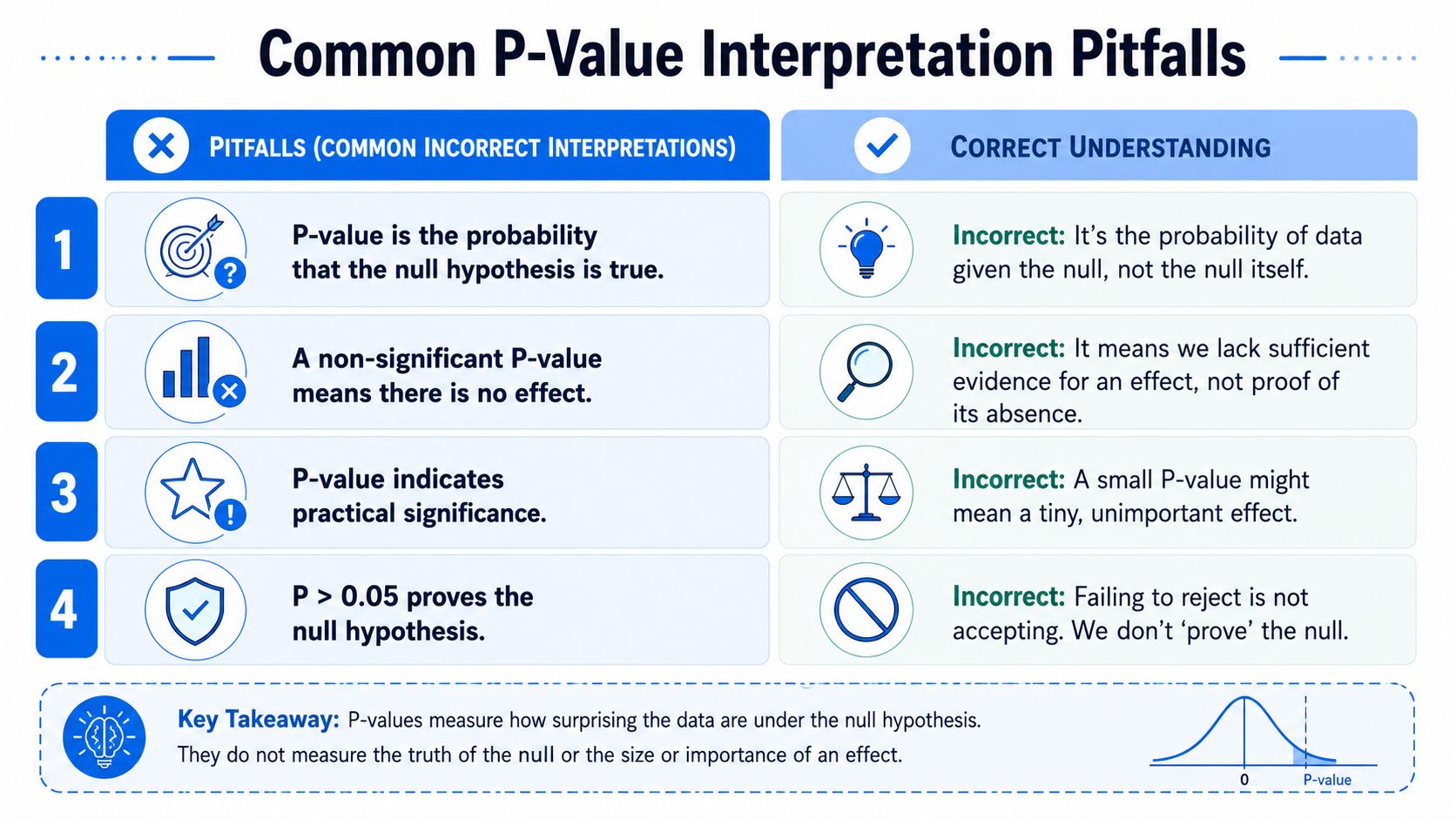
A p value is P(data | null hypothesis). It is not P(null hypothesis | data).
That difference is the whole game. Once you lose it, you start using p values as belief scores, certainty scores, or business-value scores. They are none of those things.
There's also a convention you'll see everywhere: 0.05 as the standard significance threshold. Results at or below that level are often treated as statistically significant, and results above it are often retained as not strong evidence against the null. That convention is useful, but it's only a convention. Product decisions still need context.
A Practical Example in Product Analytics
Let's make this tangible. Say your team tests a new signup button. Variant A is the current button. Variant B changes the copy and placement. The business question isn't “Did we get a p value below a threshold?” It's “Do we have enough evidence to ship this, and does the lift justify the change?”
The setup
Suppose you run the experiment and compare conversion rates between the two groups. In Python, a team might use scipy.stats or a proportions test from statsmodels to estimate whether the difference is likely due to random variation.
Here's a simplified example:
The output might be something like 0.032.
That number is useful. It is not the conclusion.

A simple Python example
If your result is p = 0.032, the plain-English interpretation is not, “There's a 3.2% chance the change doesn't work.”
The accurate version is: assuming the new button has no real effect, you'd see a result this extreme or more extreme with probability 0.032.
That's evidence against the null. But how much evidence? For product decisions, one practical framing is to grade strength rather than collapse it into yes or no. Amplitude's guide to p values in experimentation notes this rough stratification: p < 0.01 suggests strong evidence, 0.01 < p < 0.05 suggests moderate evidence, and 0.05 < p < 0.1 suggests weak evidence. The same source notes that p = 0.04 might be enough for a low-risk trial but not for a high-stakes architectural change.
That's a much better product mindset than “significant equals ship.”
If you're building an experimentation stack around product growth, this roundup of essential tools for boosting revenue is helpful because it places testing in the wider conversion workflow, not as a standalone ritual.
How to explain the result to stakeholders
Here's how I'd phrase it in a product review:
Statistical read: “The test gives moderate evidence that the new button performs differently from the current one.”
Decision read: “This may support a staged rollout if the implementation is low-risk and reversible.”
What's still missing: “Before rollout, we should look at the effect size and uncertainty range.”
That last sentence matters most. Teams that don't have a dedicated analyst often struggle less with running a test than with turning the result into an operational decision. To address this, a practical workflow for product analytics without a dedicated data analyst becomes valuable.
The Most Common P Value Interpretation Pitfalls
A product team runs an experiment on a new onboarding flow. On Tuesday, the dashboard shows p = 0.049, and the room shifts toward rollout. On Wednesday, after a few more users arrive, it reads 0.051, and the same result gets treated like a dead end.
That reaction is common, and it leads to expensive mistakes. P values rarely cause the biggest problems on their own. The bigger issue is how teams turn a noisy statistical signal into a yes or no product decision.
The cliff effect around 0.05
Many product teams treat 0.049 and 0.051 as if one proves a win and the other proves nothing. In practice, those numbers represent nearly the same level of evidence. The sharp difference comes from the rule the team applies, not from a meaningful jump in reality.
A better mental model is a dimmer switch, not a light switch. Evidence gets stronger or weaker by degree. It does not flip cleanly from false to true at one decimal point.
Key takeaway: A threshold can organize decisions, but it should never replace judgment.
That matters most when the business stakes are high. A result near 0.05 may support a reversible UI test. The same result may be too weak for a pricing change, a major acquisition bet, or a redesign that ties up engineering time for a quarter.
Peeking and p hacking
Now consider a different failure mode. A team launches a test, checks the dashboard every morning, and stops the moment the p value dips below the chosen cutoff. That process feels disciplined because it uses a number. It is still biased.
Repeated checking increases the chance that random variation gets mistaken for evidence. The team then ships because of timing luck, not because the product change produced a stable effect.
The fix starts before launch. Write down the success metric, the decision the test will support, the minimum run time, and the stopping rule. Teams that are still building their experimentation habits often benefit from a clearer grasp of what the t test is used for, because the test itself matters less than the discipline around when and how you use it.
Too many comparisons
Another trap appears when teams test many variants, many segments, or many success metrics at once. New copy. New layout. New audience slice. New retention proxy.
Each extra comparison raises the odds that one result will look persuasive by chance alone. That does not mean exploration is a problem. Exploration is how teams find ideas worth testing. The mistake is treating every interesting pattern as rollout-ready evidence.
Product reviews get cleaner when teams decide in advance which metric drives the decision and which metrics are diagnostic only. The same discipline improves dashboard design. A tighter set of key marketing metrics for 2026) helps teams focus on measures they can interpret consistently instead of reacting to every wobble on the screen.
The video below gives a concise walkthrough of why p values are so often misunderstood.
Statistical significance is not business significance
This pitfall causes the most damage to product strategy. A result can be statistically significant and still be too small to matter for adoption, retention, revenue, or support load.
The American Statistical Association's 2016 statement made the core point clearly: p values do not tell you whether a hypothesis is true, and they do not stand on their own as a basis for strong conclusions. A practical translation for product leaders is straightforward. A p value can suggest that the observed difference would be unlikely under a no-effect assumption. It cannot tell you whether the difference is large enough to justify rollout cost, engineering effort, or customer risk.
That is the shift mature teams need to make. Stop asking only, “Did it pass 0.05?” Start asking three business questions: How strong is the evidence? How large is the effect? Is that effect worth acting on in this context?
Teams that miss this distinction often confuse a clean analysis with a good decision. Those are not the same thing.
Beyond the P Value Effect Size and Confidence Intervals
If you only ask whether a result is statistically significant, you're asking too little from an experiment. A sound product decision needs three answers, not one.

Three questions every experiment should answer
Use this frame:
Question | Metric |
|---|---|
Is there evidence against the no-effect assumption? | P value |
How large is the difference? | Effect size |
How precise is the estimate? | Confidence interval |
That's the shift from binary testing to evidence-based decision-making.
A 2023 study in Nature Human Behaviour found that 67% of non-statisticians in business roles assume a low p value implies a large effect. That's a dangerous shortcut because a result can be statistically strong and practically tiny at the same time.
Why effect size changes the decision
Say an experiment returns a very small p value. That can happen because the difference is real, because the sample is large, or both. But a real difference isn't automatically a valuable one.
Effect size answers the question executives care about: How much does this move the business?
Consider two product changes:
Change A: Produces moderate evidence and a visible improvement in a core funnel step.
Change B: Produces very strong statistical evidence but the estimated improvement is so small that no user would notice and no quarterly metric would materially change.
The second result may be easier to publish in a spreadsheet. The first may be easier to justify in a roadmap.
Ask for the size of the lift before you ask for rollout dates.
Why confidence intervals matter
Confidence intervals add the missing uncertainty layer. They tell you the range of plausible values for the true effect, which is essential when the estimate could support multiple decisions.
A narrow interval suggests a more precise estimate. A wide interval tells you the effect might be meaningfully positive, negligible, or hard to pin down. That's a very different planning input.
For product teams, confidence intervals are especially useful in cases like these:
Small samples: The point estimate may bounce around, so the interval shows how uncertain you still are.
High-stakes bets: If a result could drive a large implementation effort, the range matters as much as the center.
Segment decisions: A result that looks promising overall may be uncertain within key cohorts.
Put differently, p values help you judge evidence against one story. Effect sizes and confidence intervals help you choose what to do next.
Smarter Alternatives and Reporting Standards
A product review goes off track fast when a slide says only “significant.” One stakeholder hears “safe to ship.” Another hears “big win.” A third assumes the result will hold in every segment. None of those conclusions follows from the label alone.
Good reporting should slow that down and make the decision logic visible.
A better way to report results
For product teams, the goal is not to prove that a number crossed 0.05. The goal is to show how strong the evidence is, how large the likely impact is, and what action makes sense under real business constraints.
A useful experiment summary should include:
The exact p value: Report the actual number, not only “p < 0.05,” unless a very small threshold notation is standard for your audience.
The effect size: Translate the result into business terms people can act on, such as conversion lift, retention change, or revenue per user.
The confidence interval: Show the range of plausible effects so stakeholders can see whether the result points to a meaningful win, a negligible change, or unresolved uncertainty.
A decision statement: Write one sentence on what the evidence supports, then one sentence on what still depends on cost, risk, timing, or implementation effort.
As noted earlier, researchers often misread small p values as if they measured business importance. That is exactly why the report should make evidence strength explicit instead of hiding it behind a yes or no label.
A practical internal template might look like this:
Variant B outperformed Variant A with p = [exact value]. Estimated lift was [effect size], with a confidence interval of [range]. Recommendation: evidence supports a likely improvement. Rollout decision depends on implementation cost, reversibility, and expected business impact.
That last sentence matters more than many teams realize. It connects the analysis to the decision. A 0.03 p value with a tiny upside and high engineering cost can deserve less urgency than a 0.07 p value paired with a larger possible gain and a cheap, reversible rollout.
Why some teams prefer Bayesian framing
Some product leaders prefer Bayesian methods because the outputs fit decision conversations more naturally. Instead of focusing on how unusual the data would be under a no-effect assumption, the team can discuss the probability that one variant is better and whether the expected upside clears a business threshold.
That does not make Bayesian analysis the default answer for every team. It does make the reporting standard easier to align with real product choices, especially when leaders need to weigh upside, downside, and speed. Teams trying to tighten that connection between experiment readouts and business value may also find Stimulead on marketing ROI useful because it keeps the focus on impact, not just statistical output.
Making Data-Driven Decisions with Confidence
Good p value interpretation is really decision interpretation.
The mistake isn't using p values. The mistake is asking them to do jobs they can't do. They can help you assess evidence against a no-effect assumption. They can't tell you whether the result is important, large, worth implementing, or aligned with your business constraints.
The better product habit is simple. Read the p value as evidence strength. Read the effect size as practical impact. Read the confidence interval as uncertainty. Then place all three inside the actual decision: low-risk rollout, targeted follow-up test, or no action yet.
That mindset improves experimentation discipline across teams. It also makes conversations with executives cleaner because you stop presenting a single threshold crossing as the whole story. If your organization is already tightening how it connects experimentation to business outcomes, this guide on Stimulead on marketing ROI is a useful companion because it keeps the focus on measuring impact, not just generating dashboards.
Data-driven teams don't need more asterisks. They need better judgment supported by better evidence.
Querio helps teams turn raw warehouse data into usable analysis without waiting on a stretched data team. If you want a faster way to run self-serve analytics, explore experiments, and work in Python directly on top of your warehouse, take a look at Querio.