What Is Metadata Management: A Guide to Data Strategy
Understand what is metadata management. Explore core concepts, benefits, and how to unlock self-serve analytics to scale your data team in 2026.
https://www.youtube.com/watch?v=GnqRoHstS4Y
published
Outrank AI
what is metadata management, data governance, self-serve analytics, data catalog, data lineage
cc75ecfa-ed8a-464f-8900-00287c2dfaac

Metadata management is the systematic process of organizing information about your data, like a library card catalog for your company's entire data estate, and mature programs are tied to materially faster execution: enterprises with mature metadata management were 2.4 times more likely to achieve data-driven decision-making targets, while time to create new reports dropped by 50 to 60%. In practice, that's the difference between a data team answering the same Slack questions all week and a company where people can reliably find, trust, and use data on their own.
If you're running a fast-growing startup, the pain usually doesn't look like “we need better metadata.” It looks like a product manager asking whether a dashboard is current, a finance lead questioning a KPI definition before a board meeting, or an analyst tracing a broken metric through SQL, dbt, and BI layers just to explain why two charts don't match. The team says it wants self-serve analytics, but the data function still operates like a help desk.
That's why I don't treat metadata management as a governance side project. I treat it as operational infrastructure. When it works, analysts stop acting like human APIs. They spend less time answering where a number came from and more time improving the system that produces the number in the first place.
Table of Contents
Why Your Data Team Is Drowning in Questions
A familiar scene in a startup data team goes like this. A product manager posts in Slack: “Is the sales dashboard up to date?” Ten minutes later someone else asks which signup table is the canonical one. Then RevOps wants to know why pipeline numbers in the warehouse don't match the CRM export.
None of these are hard questions in isolation. The problem is the repetition. Analysts answer them over and over because the context lives in too many places: dbt docs, BI dashboards, Notion pages, old SQL snippets, and a lot of tribal knowledge inside one or two people's heads.
That's where teams start confusing activity with progress. They're busy, but they're not compounding. Every new dashboard creates fresh dependency unless the system also captures ownership, definitions, freshness, lineage, and usage context.
The hidden cost of being the human API
When metadata is weak, the data team becomes a translation layer between the warehouse and the business. People don't just ask for numbers. They ask what table to trust, whether the definition changed, who owns the pipeline, and whether a metric is safe for decisions.
The bottleneck usually isn't SQL. It's missing context.
The result is predictable. Analysts spend time validating instead of analyzing. Engineers get pulled into incident triage because nobody can quickly trace upstream dependencies. Product and GTM teams hesitate to self-serve because they've already been burned by conflicting answers.
A lot of companies try to solve this with more dashboards. That helps for recurring questions, but it doesn't solve the underlying problem. Self-serve only works when users can discover the right asset, understand what it means, and trust how it was produced. A good overview of that shift appears in this piece on self-serve business intelligence.
What metadata management fixes
What is metadata management in practical terms? It's the system that captures and maintains the context around data assets so people can answer those questions without opening a ticket every time.
That includes things like:
Ownership: Who is responsible for a table, metric, or dashboard.
Meaning: What a field or KPI represents in business terms.
Lineage: Where the data came from and what transformed it.
Operational state: How often it refreshes, how heavily it's used, and whether there are known issues.
Once that context is centralized and kept current, the company stops relying on memory and starts relying on infrastructure. That's the point. Not prettier documentation. Faster decisions with less analyst intervention.
The Three Core Types of Metadata You Must Understand
Individuals often hear “metadata” and think of schema details. That's only one slice of it. If you want metadata management to improve speed, not just satisfy a governance checklist, you need three types working together inside a centralized repository tied to a catalog and policy layer. According to Athena Solutions' guide to metadata management, that setup can reduce manual approval cycles by 30 to 50% and cut data-related incidents by 40 to 60% over 12 to 18 months.
The easiest way to explain this is with a single example. Take a table called user_signups. One team may know the columns. Another may know what “qualified” means. A third may know that the table lags after a specific upstream job. If those facts stay separated, nobody really understands the asset.
Why one type alone never works
Technical metadata without business metadata gives you a well-labeled machine no one outside engineering can use. Business metadata without operational metadata gives you definitions that sound right but may not reflect current system behavior. Operational metadata without ownership leaves everyone aware of a problem but unsure who should fix it.
That's why passive catalogs often disappoint. They ingest table names and column types, but they don't create enough context for confident self-service. If you want a sharper view of that difference, this article on active metadata and why it matters for BI is worth reading.
A simple way to classify metadata
A good mental model is a library book.
Metadata Type | Purpose | Examples |
|---|---|---|
Technical metadata | Describes structure and system details | Table schema, column names, data types, primary keys, downstream dependencies |
Business metadata | Explains meaning in company language | Metric definitions, owner, approved use cases, glossary terms, SLA |
Operational metadata | Shows runtime behavior and usage | Refresh frequency, query volume, latency, access patterns, incident history |
Here's how that maps to user_signups:
Technical metadata tells you the table lives in Snowflake, includes
signup_atandchannel, and feeds a dbt model used by a Looker dashboard.Business metadata tells you a “signup” excludes internal users, attributes channel based on first-touch logic, and is owned by Growth Ops.
Operational metadata tells you it refreshes every morning, is queried heavily before weekly exec reviews, and had a recent freshness incident.
Practical rule: If a business user can find a dataset but still has to ask Slack what it means or whether it's safe to use, your metadata layer is incomplete.
This is also where policy enforcement gets real. When technical, business, and operational metadata live together, teams can drive actions from metadata instead of relying on manual review. That's how you get masking rules, approval workflows, and clearer self-serve boundaries without turning every access request into a custom process.
The mistake I see most often is treating metadata as a documentation exercise. It isn't. It's a context system. And context is what lets the business move without constantly waiting on the data team.
Building Your Data's Central Nervous System
A modern metadata layer works more like city infrastructure than a wiki. You need a map, traffic flow, rules, and people accountable for specific areas. Without that, data stays technically available but operationally unreliable.

The architecture behind what is metadata management usually comes down to four connected parts: data catalog, data lineage, data stewardship, and data governance. Treat them as one operating system, not four isolated initiatives.
The four parts that make the system work
Data catalog is the city map. It tells people what assets exist, how to search them, and which ones are official. If your catalog only lists raw tables without business context, it becomes a technical index instead of a decision tool.
Data lineage is the road and utility network. It shows how data moves from source systems through transformations into models, dashboards, and applications. According to GetCollate's overview of metadata management, effective platforms can connect to hundreds of data sources and automatically infer lineage by parsing SQL scripts and orchestration code, increasing coverage to 80 to 90% of critical pipelines within 6 to 12 months.
A semantic layer often sits close to this structure because it standardizes business meaning on top of technical assets. If that topic is relevant to your stack, this explanation of what a semantic layer is fits naturally alongside metadata strategy.
After the image, it helps to see the concept explained in a different medium:
Data stewardship is the ownership model. Every critical asset needs a named steward, even if stewardship is distributed. In startups, this doesn't need a large governance office. It can be a product analyst owning growth metrics, a finance manager owning revenue definitions, and a data engineer owning the ingestion health for source systems.
Data governance is the rulebook. It defines who can use what, which definitions are approved, what sensitivity tags mean, and how policy enforcement works. Good governance is precise and lightweight. Bad governance slows everything down and teaches teams to work around it.
What breaks when one part is missing
You can usually diagnose a weak metadata system by the failure mode:
No catalog: People rebuild existing work because they can't find trusted assets.
No lineage: Incidents take too long because teams can't trace what changed.
No stewardship: Definitions drift because nobody owns business meaning.
No governance: Sensitive data handling becomes inconsistent across tools.
The trade-off is straightforward. The more manual this system is, the faster it decays. That's why code parsing, connector coverage, and automated synchronization matter so much. A catalog that requires constant hand entry won't survive a fast-moving startup.
Build the metadata layer close to where work already happens: warehouse, transformation code, orchestration, and BI. If people have to maintain it separately, they usually won't.
From Compliance to Competitive Advantage The Real ROI
The wrong way to sell metadata management is to pitch it as paperwork for auditors. That matters, but it's not what gets startup leaders to care. They care when metadata shortens reporting cycles, improves trust in numbers, and lets more teams answer their own questions without pulling analysts into every thread.
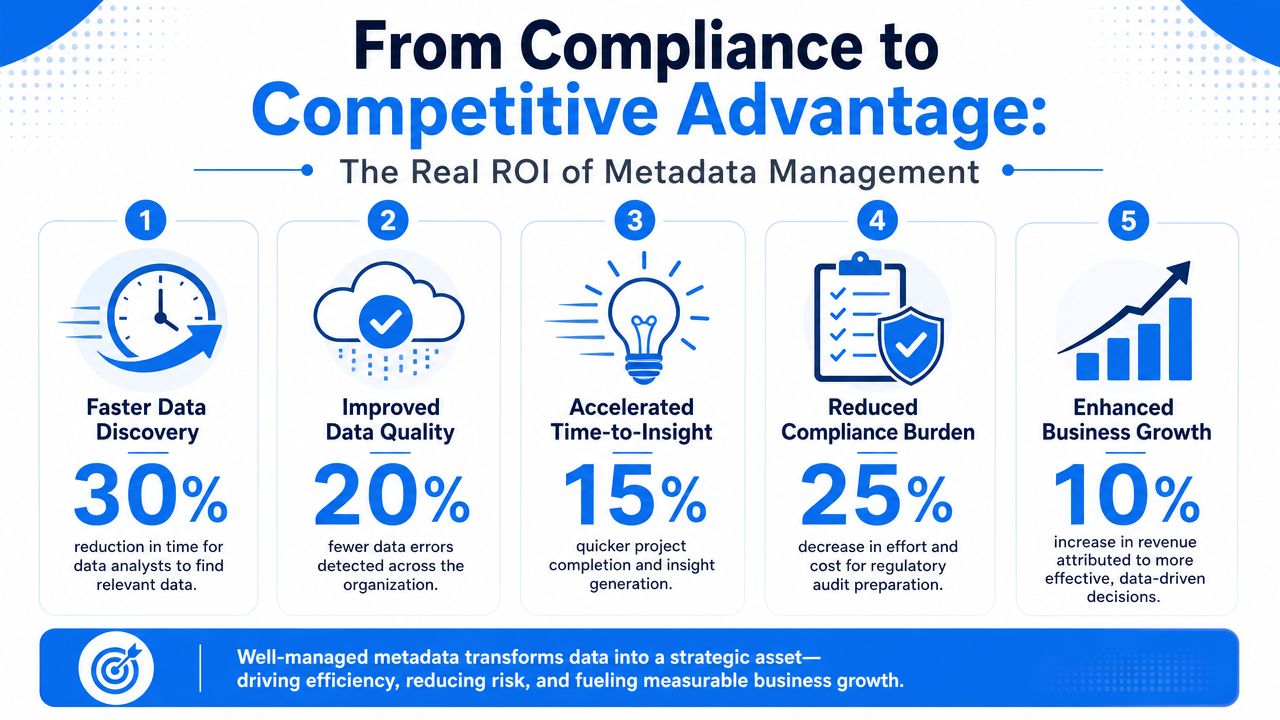
The strongest quantified case comes from mature enterprise environments. According to IBM's summary of metadata management research, a 2022 Gartner assessment found that organizations with mature metadata management were 3.8 times more likely to meet regulatory audit timelines and 2.4 times more likely to achieve data-driven decision-making targets. The same source notes Forrester estimated time to create new reports or dashboards dropped by 50 to 60%.
What leaders actually get back
Those numbers matter because they point to a significant operational benefit, not just cleaner documentation.
A mature metadata layer improves work in four ways:
Faster report creation: Teams spend less time rediscovering joins, definitions, and trusted sources.
Higher confidence in metrics: Users can inspect lineage and ownership before escalating a discrepancy.
Less process drag: Governance becomes embedded in the system rather than handled through repeated manual approvals.
More realistic self-service: Business teams can answer common questions safely because the context is attached to the data.
There's also a practical speed gain that leaders feel immediately. If a dashboard breaks before an exec review, the team with lineage and ownership metadata starts investigation at the likely source. The team without it starts with Slack, guesswork, and a lot of “who changed this?”
Why compliance is only the floor
Compliance outcomes are valuable, but they're downstream of a healthier operating model. Metadata creates a shared understanding of what assets exist, which ones are official, and how changes ripple through the stack. That is what makes speed sustainable.
For leaders thinking about broader operating discipline, metadata management also overlaps with data governance. The distinction is useful: governance sets the rules, while metadata makes those rules actionable and visible in day-to-day work.
Good metadata doesn't just answer “can we pass an audit?” It answers “can the company move faster without breaking trust in the numbers?”
That's the ROI. Not just fewer surprises during compliance reviews, but a data function that scales by creating reusable context instead of repeatedly supplying one-off answers.
A Practical Roadmap for Implementing Metadata Management
Most metadata programs fail for boring reasons. They start too broad, depend on manual upkeep, or get framed as an IT initiative instead of a business-speed initiative. The better path is narrower and more disciplined.

There's good reason to take this seriously now. According to EW Solutions' metadata management fundamentals, adoption accelerated sharply between 2017 and 2022. By 2020, the share of large organizations with a formal strategy had nearly doubled to 61% from 32% in 2016, 45% cited GDPR and related privacy regulations as a primary driver, and early adopters saw a 25 to 35% reduction in time-to-insight for data discoveries.
Start with one painful domain
Don't begin with “enterprise metadata.” Begin with a business problem that keeps creating drag.
Good pilot domains usually have three traits:
High question volume: Revenue, signup, activation, and pipeline metrics are common examples.
Clear pain: People already complain that numbers don't match or take too long to verify.
Cross-functional relevance: The domain matters to product, finance, GTM, or leadership, so improvements are visible.
Pick one domain and define what success means in operational terms. Fewer repetitive Slack questions. Faster incident triage. Easier onboarding for new analysts. More confidence in a core dashboard set.
Then document the minimum viable context for that domain:
canonical assets
owner
business definitions
lineage
refresh expectations
sensitivity tags where relevant
How to scale without creating a documentation tax
After the pilot, the next decision is tooling. At this stage, trade-offs are important.
A passive catalog can be enough if your environment is small and changes slowly. But fast-moving teams usually need a system that syncs from the warehouse, transformation layer, orchestration tool, and BI layer automatically. If metadata lives in a side system nobody updates, it becomes stale almost immediately.
A practical rollout usually looks like this:
Formalize stewardship lightly: Assign owners to business domains, not every single column on day one.
Automate first where possible: Ingest schemas, parse SQL, and capture lineage from existing code and jobs.
Attach policy to metadata: Use sensitivity labels, approved definitions, and access rules in the same system.
Review usage patterns: Prioritize the assets people rely on most, not the long tail of rarely touched tables.
One more rule matters a lot. Don't chase perfect coverage. A startup does not need every asset fully documented before metadata starts paying off. It needs the most decision-critical assets to be discoverable, understandable, and trustworthy.
Treat metadata like product infrastructure. Ship the highest-value version first, instrument adoption, and expand based on where the business feels the most friction.
What doesn't work is a big-bang governance program run entirely from the center. That often produces a long spreadsheet of standards and very little behavior change. The teams closest to the metrics need to participate in definitions and ownership, or the metadata won't match reality for long.
The Future of Data Teams Is Self-Serve Analytics
The long-term value of metadata management isn't that your catalog looks tidy. It's that the data team changes roles. Instead of answering every question manually, the team builds a trusted context layer that lets others explore safely.
That shift becomes more important as companies adopt AI-assisted analytics and code-first workflows. Warehouses, dbt projects, notebooks, orchestration jobs, and downstream apps change too quickly for manual documentation to keep up. Metadata has to become active. It has to update as the system changes.

Active metadata changes the operating model
Recent industry analysis summarized by Informatica's article on metadata management notes that organizations using AI for metadata lineage and anomaly detection can reduce data incident investigation time by up to 40%. That matters because faster investigation means less downtime, less executive confusion, and less analyst time spent reconstructing what happened.
In startup settings, the operational point is even bigger than the incident metric. Active metadata turns context into a live system asset. SQL changes can trigger lineage updates. Ownership can follow deployment patterns. Usage signals can show which assets deserve tighter quality controls and which can be deprecated.
Why AI agents need context not just access
AI agents can query a warehouse. That doesn't mean they understand the business. Without metadata, an agent can still choose the wrong table, misread a metric definition, or ignore a freshness issue. Access alone is not enough.
A useful self-serve and AI-ready stack needs:
Trusted business meaning: Clear metric definitions and approved entities.
Current lineage: So the system can reason about upstream dependencies and impact.
Ownership and policy context: To route issues and avoid unsafe access patterns.
Operational signals: Freshness, usage, and anomaly context that shape how results should be interpreted.
That's the answer to what is metadata management for modern teams. It's not static documentation. It's the context layer that makes self-serve analytics credible and AI automation safe enough to use in production workflows.
If your analysts still spend most of their time answering where data came from, what a metric means, and whether a dashboard is safe to trust, the company doesn't have a self-serve model yet. It has a queue. Metadata management is how you replace the queue with infrastructure.
If your data team is overloaded and your business still depends on analysts to answer routine questions, Querio is built for that transition. It deploys AI coding agents directly on your warehouse so teams can move from ticket-driven analytics to self-serve infrastructure, with the context and flexibility needed for real work instead of canned dashboards.