What Is a Single Source of Truth? Your 2026 Guide to SSOT
Struggling with conflicting data? Discover what is a single source of truth (SSOT) and how to build one for reliable, data-driven decisions in 2026.
https://www.youtube.com/watch?v=x5oC545xBoc
published
Outrank AI
what is a single source of truth, data governance, data management, ssot, data warehouse
a75adcc6-4e43-4240-bdab-315088202d55

You're probably already feeling the symptoms of not having a single source of truth, even if nobody in the company calls it that.
The board deck says net revenue retention is one number. Finance has another. Marketing insists pipeline is up. Sales says the CRM tells a different story. Product wants weekly active users defined one way, while customer success reports a different count from a separate dashboard. Nobody is lying. Everyone is pulling from a system they trust. The problem is that the business has multiple answers to the same question.
That's when founders usually realize this isn't a reporting issue. It's a company design issue. If teams can't agree on what happened, they can't make confident decisions about what to do next. That's what makes the question of what is a single source of truth so important. It's not a data-team pet project. It's the operating model for a company that wants to scale without arguing over spreadsheets.
Table of Contents
The High Cost of Conflicting Data
Monday morning. The leadership team is in the forecast meeting, and three teams bring three different revenue numbers. Marketing is reading from the automation platform, sales from the CRM, and finance from an ERP export. The discussion shifts immediately. Instead of deciding whether to hire, cut spend, or change targets, the room gets stuck on date ranges, attribution rules, and whose definition of "customer" counts.
That kind of conflict is not a reporting nuisance. It is a decision-making failure.
I have seen this happen in growing companies that invested heavily in tools but never agreed on the underlying model. The result is predictable. Every team builds a version of the business that makes sense locally, then leadership has to sort out the contradictions in the meeting where speed matters most. If you are trying to fix that pattern, start with the operational root cause: breaking down data silos across systems and teams.
Trust breaks before systems do
The first thing to fail is not the warehouse or the dashboard. It is trust.
Once teams see conflicting numbers often enough, they change their behavior. Finance keeps a separate spreadsheet. Sales asks for a custom pull before every board deck. Product stops relying on the KPI dashboard and builds its own report. Executives start asking analysts for "the definitive number," which usually means "the number I can defend in a high-stakes meeting."
That shift is expensive because it turns the data function into a manual verification layer. Analysts spend their time tracing lineage, comparing exports, and explaining why two reports disagree, instead of helping the business improve retention, pricing, pipeline quality, or product adoption.
When teams stop trusting shared metrics, every important decision needs a human referee.
The waste is larger than it looks
The visible problem is a bad meeting. The larger problem is the operating drag that follows.
Conflicting data creates rework across the business. Forecasts take longer to close. Planning cycles stall. Teams delay launches because nobody is confident in baseline numbers. In commerce and catalog-heavy businesses, the same issue shows up in product data too. SKU mismatches, inconsistent naming, and duplicate records create the same kind of confusion that bad metric definitions create in analytics. The insights from Kogifi on PIM are a useful parallel. If the core record is inconsistent, every downstream workflow gets slower and less reliable.
This is why a single source of truth is not just a BI cleanup project. In a modern warehouse-first stack, the warehouse becomes the place where metric definitions, business logic, and core entities are standardized once and reused everywhere. Then self-service tools such as Querio can sit on top of that foundation and give non-technical teams access to trusted answers without creating yet another layer of conflicting logic.
A company can grow for a while with competing spreadsheets and tool-level reports. It cannot scale decisions that way.
Defining the Single Source of Truth
Most definitions of SSOT sound academic. They're technically right, but they don't help much when you're deciding how to structure your data stack or explain the priority to a founder.
A better way to think about it is this: an SSOT is the master blueprint for how the business understands its own data. Every team can build from it, but nobody should be drawing different floor plans for the same building.
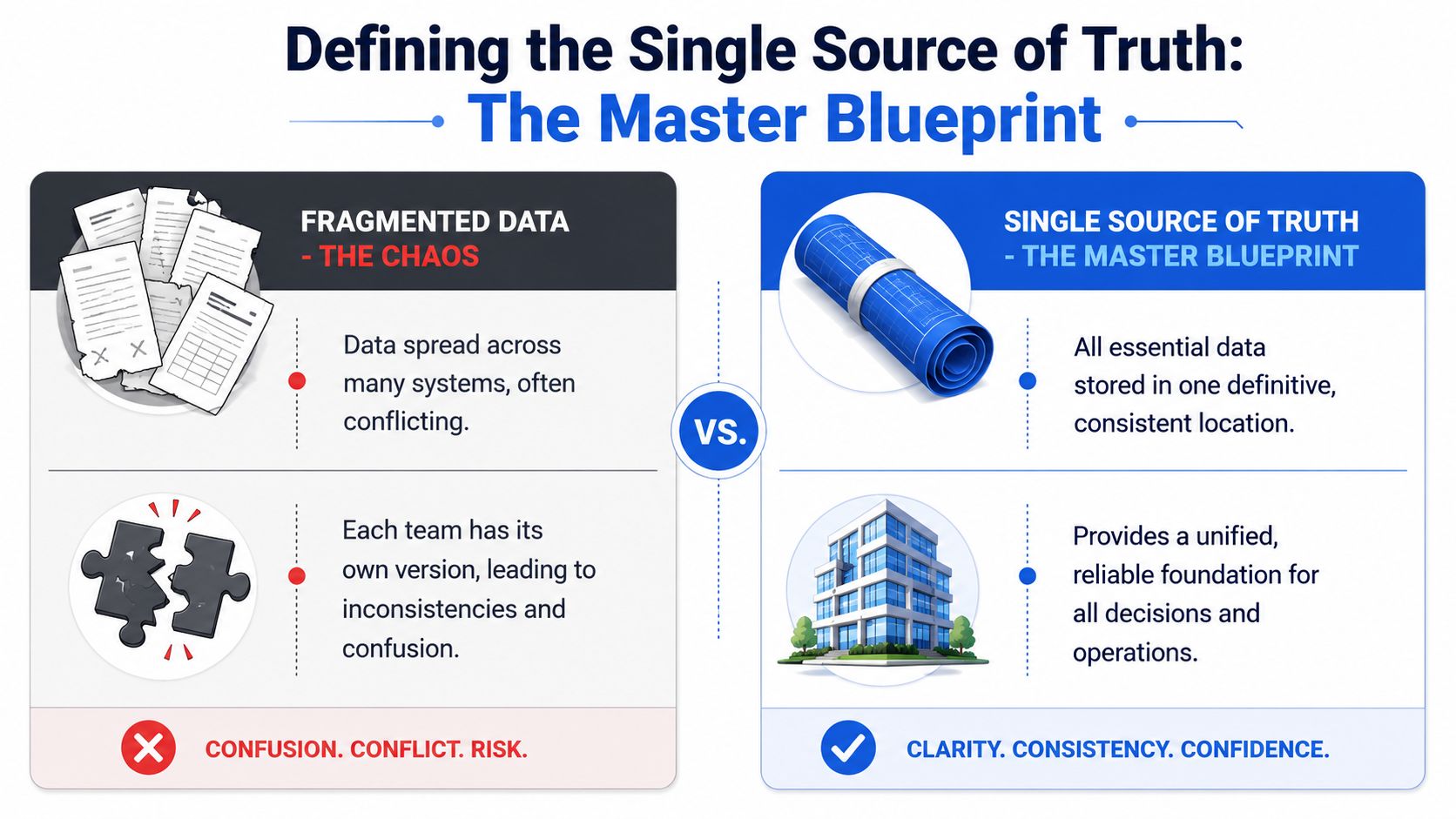
Think of it as the master blueprint
In construction, the blueprint tells everyone where the walls, doors, and windows go. Electricians, plumbers, architects, and inspectors may each focus on different parts of the project, but they work from the same plan. If each team used its own drawing, the building would fail in slow, expensive ways.
Data works the same way. Sales, finance, product, and marketing all need different views, but those views should come from a shared underlying model. In information architecture, a Single Source of Truth means every data element is mastered in exactly one location, which creates a canonical form and prevents version drift, as described in Wikipedia's summary of SSOT in information architecture.
That definition matters because it cuts through a common mistake. Many companies think they have an SSOT when they really have a popular dashboard. A dashboard can be widely used and still sit on top of inconsistent logic, duplicated transformations, or undocumented assumptions.
Practical rule: If two people can define the same KPI differently without breaking any process, you don't have an SSOT yet.
This is also why a semantic layer matters. The warehouse may hold the data, but the business still needs consistent definitions for revenue, active user, qualified pipeline, and churn. That's the role of a semantic layer in analytics.
For teams managing complex product data, the same logic shows up in commerce operations. The insights from Kogifi on PIM are useful here because product information management has the same core challenge: one authoritative product record has to feed multiple channels without drifting into conflicting versions.
SSOT vs SVoT vs SoR
These terms get mixed together constantly. They shouldn't.
Concept | Primary Purpose | Example |
|---|---|---|
SSOT | Create one trusted, unified foundation for analysis and decision-making | A cloud data warehouse with governed models for revenue, customers, and product usage |
SVoT | Give a specific team or workflow one agreed interpretation of data | A finance reporting pack that applies one approved revenue-recognition logic |
SoR | Serve as the operational system where data is originally created or maintained | Salesforce for opportunities, NetSuite for billing, HubSpot for marketing contacts |
The distinction matters in practice.
A Source of Record is usually operational. It's where a team enters or updates business facts. A CRM is a SoR for opportunities. An ERP is a SoR for invoices. A support platform may be a SoR for tickets.
A Single Version of the Truth is narrower. It's often a standardized report or agreed reporting lens for a particular use case. Useful, but not broad enough to anchor company-wide analytics on its own.
An SSOT sits above those systems and reconciles them into a governed, trusted analytical layer. That's why modern teams usually build it in the warehouse rather than forcing one operational tool to become the answer to everything.
The Business Case for an SSOT
Monday morning, the CEO asks for net revenue retention, the VP Sales shares one number, Finance shares another, and Product shows a third pulled from the warehouse. The problem is not reporting polish. The problem is that the company cannot make a confident decision until someone spends half the day reconciling definitions.
That is why an SSOT becomes a leadership issue early, often before the company realizes it. Growth plans, hiring decisions, board updates, pricing changes, and sales targets all depend on the same thing: a set of numbers the business agrees to use.
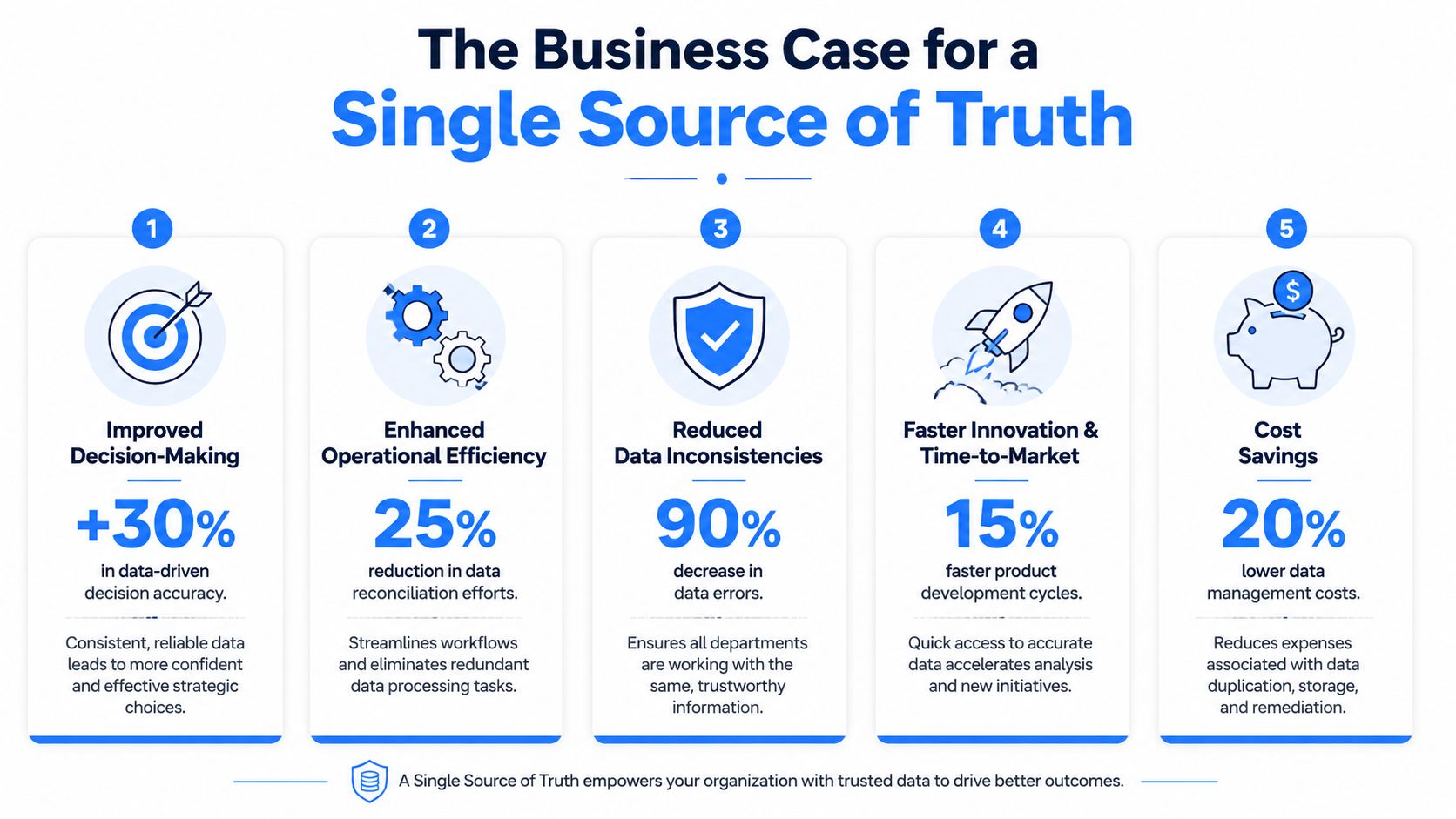
Why this becomes a board-level issue
An SSOT changes the quality of executive conversations.
Without one, strategic meetings drift into metric arbitration. Finance questions pipeline coverage. Sales questions churn logic. Product questions account definitions. Everyone brings evidence. Nobody trusts the full picture. The cost is not only bad reporting. It is slower decisions, weaker accountability, and less conviction in the plan.
I have seen this pattern repeatedly in startups moving from founder-led reporting to functional ownership. At a certain scale, spreadsheet heroics stop being a sign of hustle and start becoming an operating risk.
A short explainer can help make the point internally:
Where the return comes from
The payoff from an SSOT is usually practical and visible within a quarter.
Faster decisions: Teams spend less time validating numbers and more time acting on them.
Lower operating drag: Analysts stop rebuilding the same joins and definitions across dashboards, spreadsheets, and one-off requests.
Tighter cross-functional alignment: Finance, go-to-market, and product use the same metric logic, so planning discussions start with decisions instead of reconciliation.
Better self-service: Business teams can answer more questions on their own once the warehouse has governed models and clear definitions.
That last point matters more than many teams expect. A warehouse-first SSOT does not create value just by centralizing data. It creates value when people across the company can use that data safely. That requires clear ownership, metric definitions, and data governance practices that hold up under growth.
There is also a hard cost to delay. When every KPI needs manual validation, planning cycles lengthen, reporting work piles up on a small data team, and expensive leaders spend time debating inputs instead of choosing a direction.
A messy data environment does not only produce bad reports. It produces slower management.
This is why I frame an SSOT as an operating model, not a cleanup project. In a modern warehouse-first stack, the warehouse holds the governed truth, and tools such as Querio help business teams query that trusted layer without creating another shadow reporting system. The result is simple. Fewer reporting arguments, faster answers, and a management team that can run the company on shared facts.
SSOT Architecture and Governance Models
An SSOT stands or falls on two decisions. Where does the company's trusted analytical data live, and who has the authority to define it?
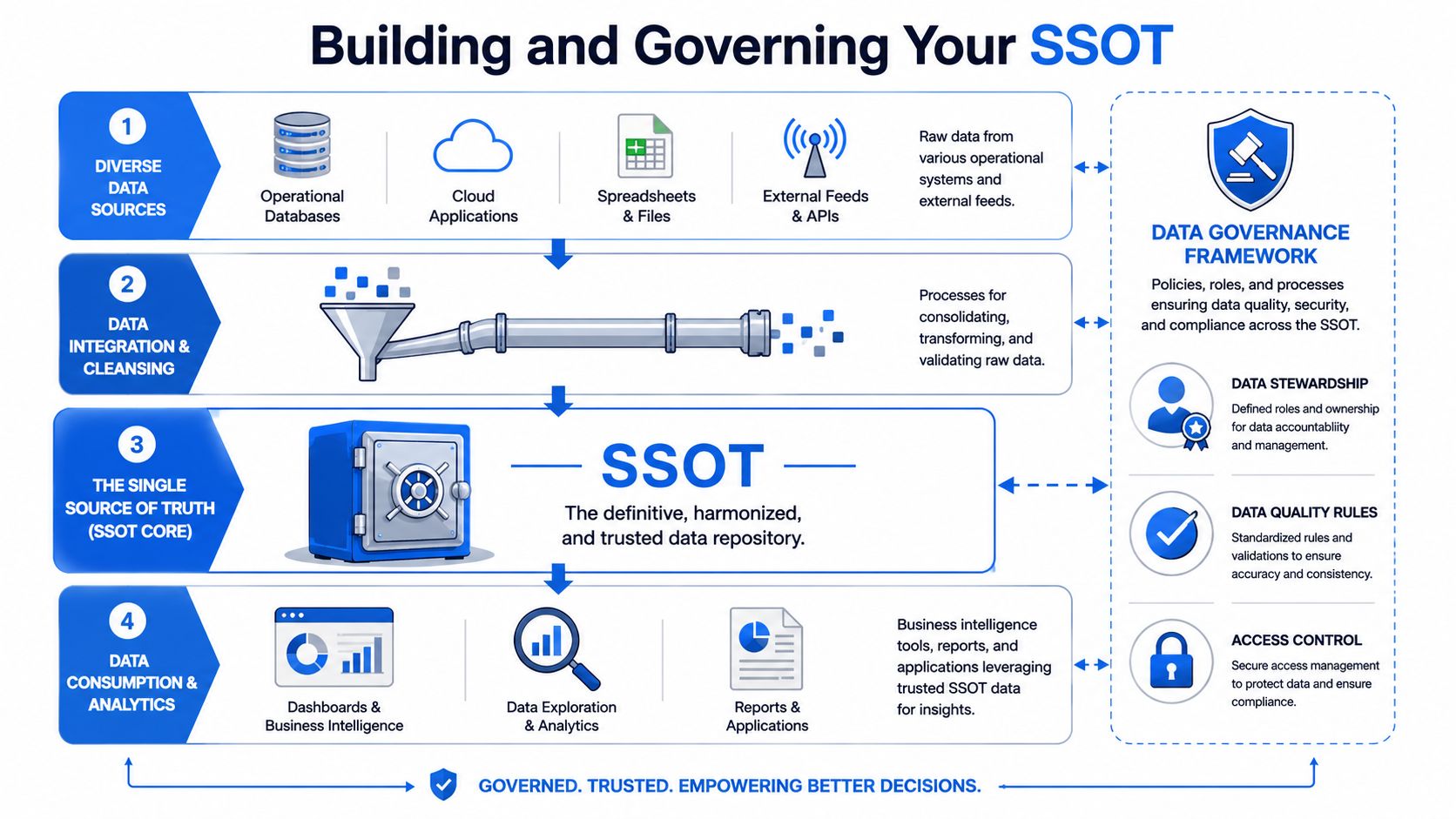
The architecture in practice
For a modern startup, the warehouse is usually the center of the SSOT. Operational systems still create the records. Salesforce tracks pipeline, Stripe records payments, NetSuite closes the books, and product databases capture usage. The warehouse is where those records get cleaned, joined, and standardized so the business can use one version of customer, revenue, and activity data.
The goal is not to force every team into one application. The goal is to give every team one trusted analytical layer.
That distinction matters. Startups rarely have a single operational system. They have a stack. An SSOT works by accepting that reality and creating a governed path from source systems into shared models in Snowflake, BigQuery, or Redshift. From there, dashboards, finance reports, notebooks, and self-service tools should all read from the same modeled layer.
A healthy setup usually includes:
Reliable ingestion: Data arrives from source systems on a cadence the business can plan around.
Modeled core entities: Customer, account, subscription, invoice, opportunity, campaign, and product usage tables connect cleanly.
Shared metric logic: Revenue, retention, pipeline, and activation definitions are written once and reused.
Controlled consumption: BI tools, reverse ETL workflows, and query interfaces pull from governed models instead of local extracts.
In warehouse-first teams, this is the point where architecture stops being abstract. A good model layer reduces rework for analysts and gives business users a safer way to answer their own questions. Tools like Querio are useful here because they sit on top of the warehouse rather than creating another reporting store, which helps self-service stay tied to governed definitions.
Governance is what keeps it credible
The warehouse can centralize data. It cannot settle ownership disputes.
Every SSOT needs a simple governance model that answers four operational questions: who defines a metric, who maintains data quality, where definitions are documented, and who gets access to what level of detail. If those decisions stay fuzzy, the technical stack drifts fast. One team changes the churn logic, another filters out internal accounts differently, and within a quarter the company is back to arguing over numbers.
The minimum version looks like this:
Governance element | What it answers |
|---|---|
Data owner | Who approves the business meaning of a metric or domain |
Data steward | Who monitors quality, exceptions, and definition drift |
Business glossary | What terms like customer, MRR, active user, and churn mean in company reporting |
Access policy | Who can see what, and at what grain |
This does not need a heavy committee structure. Early-stage companies usually do better with clear domain ownership. Finance owns recognized revenue. Sales leadership owns pipeline stage policy. Product owns activation events. The data team translates those decisions into warehouse models and tests.
If you are building this from scratch, start with data governance practices that people will use, not a policy document that sits in a folder unread.
Governance is the operating agreement that keeps your metrics stable under pressure.
That pressure shows up faster than founders expect. Board prep, a pricing change, a new market launch, or an acquisition will test whether your SSOT is a real management system or just a cleaned-up warehouse.
How to Implement a Single Source of Truth
Most SSOT projects fail for one reason. They start too wide.
If you try to unify every data source, every metric, and every workflow in one motion, you'll create a long technical program with weak adoption. The pragmatic route is narrower. Start with one business decision that matters, then build outward.
Start with a business decision not a data model
Pick a domain where disagreement is already expensive. For many startups, that's sales reporting, marketing attribution, or revenue reporting. The choice should reflect where executive decisions are currently slowed by conflicting numbers.
Then do the unglamorous work:
Get executive backing. Someone at the leadership level has to say which business process gets standardized first.
Audit the source systems. Identify where the data originates, where it gets copied, and where definitions diverge.
Choose the authoritative path. Decide which systems create records, which transformations standardize them, and where the final analytical model lives.
Write definitions down. “Obvious” metrics cause the most trouble because everyone assumes they already agree.
Clean before you consolidate. Duplicate accounts, malformed timestamps, missing IDs, and inconsistent currency handling will otherwise move into the new system intact.
This is usually where companies discover that SSOT is as much an operating agreement as a technical build. Workday notes that milestones in SSOT adoption include organizational buy-in, appointment of data owners, and major data cleansing to standardize formats before migration to the central platform. That aligns with what works in practice, even if the tooling differs.
Roll it out in phases
A phased rollout beats a big-bang migration almost every time.
One workable sequence looks like this:
Phase one: Standardize a high-friction reporting area such as pipeline or revenue.
Phase two: Expose the governed models through dashboards and query tools.
Phase three: Expand to adjacent functions such as customer success, product analytics, or forecasting.
Phase four: Add audits, lineage, and access controls as usage broadens.
What doesn't work is declaring the warehouse the SSOT on Monday and expecting trust by Friday. Trust comes from repeated proof. A metric matches reality. A definition holds up under pressure. A dashboard survives a board meeting without anyone asking for a spreadsheet backup.
Adoption also needs training. People must know where to go, what definitions to trust, and when to stop using old reports. If the legacy spreadsheet still feels easier, the SSOT hasn't succeeded.
Unlocking Your SSOT with Warehouse-First Analytics
Monday morning, the founder asks a simple question about pipeline coverage before the board meeting. The numbers exist in the warehouse, the definitions are documented, and the dashboards are live. The problem is that only two people know which model to trust, so everyone waits for an analyst anyway.
That is the gap warehouse-first analytics is meant to close.
A central warehouse gives the business one governed foundation. It does not, by itself, change how decisions get made. If business users cannot find the right model, ask questions safely, or trust what they see without opening a ticket, the SSOT remains a back-office asset instead of an operating system for the company.
The warehouse is the foundation, not the finish line
In a modern stack, the data warehouse holds the cleaned, joined, governed version of the business. That is the right place for the SSOT because it keeps definitions close to the raw data, the transformation logic, and the audit trail.
But founders should be clear-eyed about the trade-off. A warehouse-first approach improves control and consistency, yet it can also centralize access too tightly if every question still has to pass through SQL. I've seen teams build a strong warehouse and still miss the business benefit because the last mile was ignored. Sales asks for one KPI cut. Finance wants a slightly different filter. Product needs a retention slice by afternoon. The data team becomes a reporting queue with better infrastructure.
What good self-service looks like on top of an SSOT
The answer is not adding another disconnected BI layer with its own metric logic. That recreates the same trust problem in a prettier interface.
The answer is to let people work directly from the governed warehouse layer through tools built for warehouse-first analytics. Analysts still define models, permissions, and shared business terms. Business teams get access to those approved definitions in a form they can use without copying raw tables into spreadsheets or side databases.

That is where Querio fits. In a warehouse-first setup, it connects to the warehouse and lets technical and non-technical users query, analyze, and build from governed company data without routing every request through an analyst. The value is practical. Faster answers for operators, fewer duplicate queries for the data team, and less metric drift across functions.
An SSOT starts paying off when teams can run the business from the same trusted layer.
That changes the role of the data team. Instead of rebuilding the same dashboard logic in multiple tools, they maintain the core models and access rules once, then give the rest of the company a safe way to use them. For a startup, that is not just better analytics hygiene. It is how the company gets speed without losing control.
From Data Chaos to Strategic Clarity
A single source of truth isn't a dashboard, a warehouse, or a governance document by itself. It's the combination of shared architecture, shared definitions, and shared discipline that lets a company run on one set of facts.
That's why the question of what is a single source of truth matters far beyond the data team. An SSOT affects planning quality, operating speed, and how much confidence leaders have in the numbers they use to steer the business. Without it, every major decision carries an extra tax: someone has to ask whether the underlying data is trustworthy.
The companies that benefit most don't chase perfection first. They pick a painful domain, define it properly, assign ownership, and build a warehouse-centered foundation that can support broader use over time. Then they make that foundation accessible through tools and workflows people will use.
Strategic clarity doesn't come from having more dashboards. It comes from reducing ambiguity at the source and giving the organization one reliable way to understand performance.
If your team has already centralized data but still relies on analysts to answer every question, Querio is worth a look. It sits on top of the warehouse-first foundation you've built and helps turn governed data into usable self-service analytics, so your data team can focus on standards and infrastructure instead of acting as a reporting queue.